Why a crack in the door is more than a looks problem
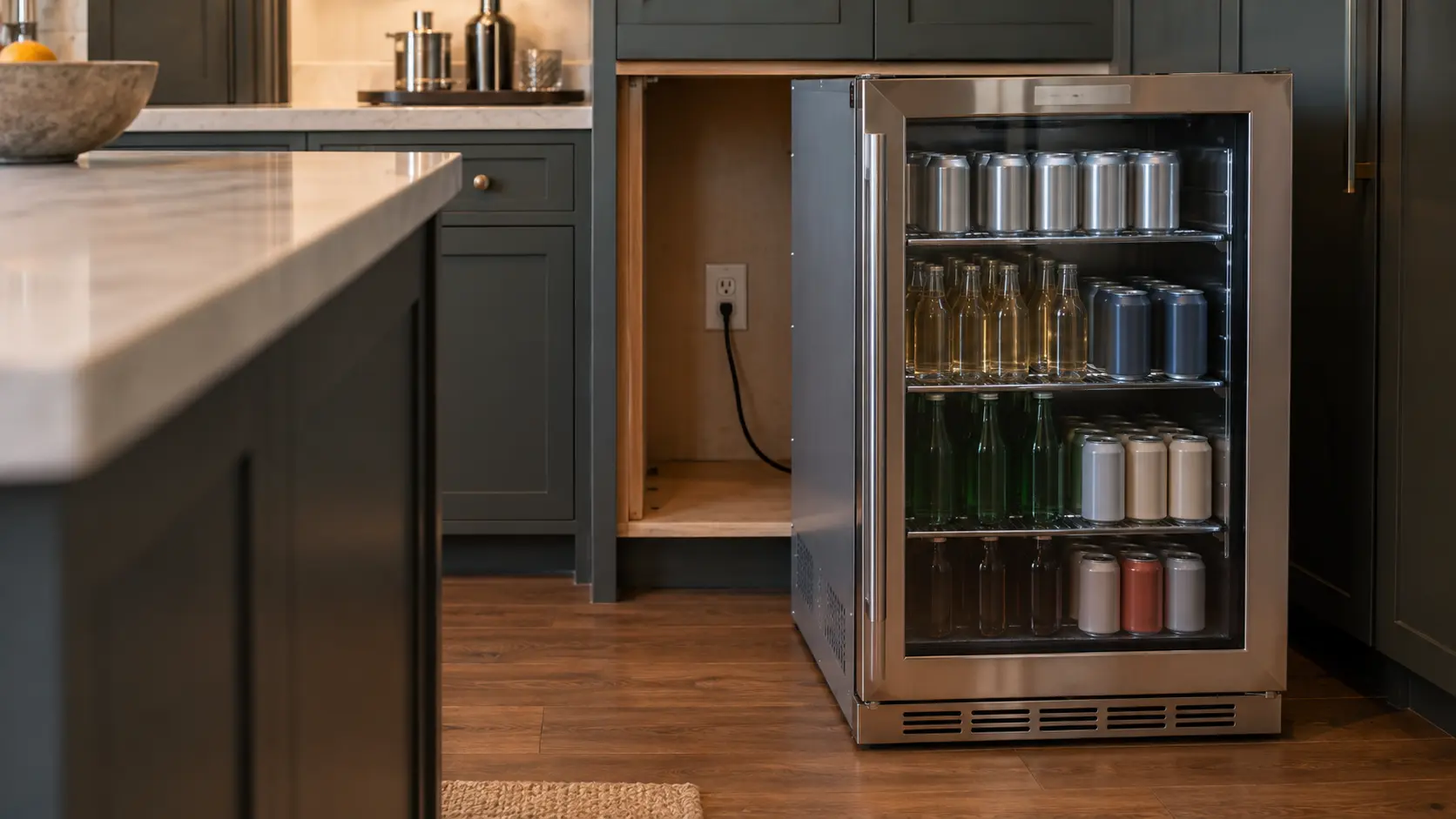
The glass front is why most people choose a beverage center: every can and bottle in view without letting the cold out. It also takes the most punishment, pulled open dozens of times on a party night and nudged shut with a knee.
When the door glass is tempered, the federal glazing rule that CPSC enforces describes what to expect: the glass is heat or chemically treated so it cannot be cut or drilled afterward, and when a highly tempered piece fractures at any point, the entire piece breaks into small particles. Small pieces are far kinder than long shards, but a door-sized pane letting go at once still spreads a carpet of glass across a kitchen or basement bar floor.
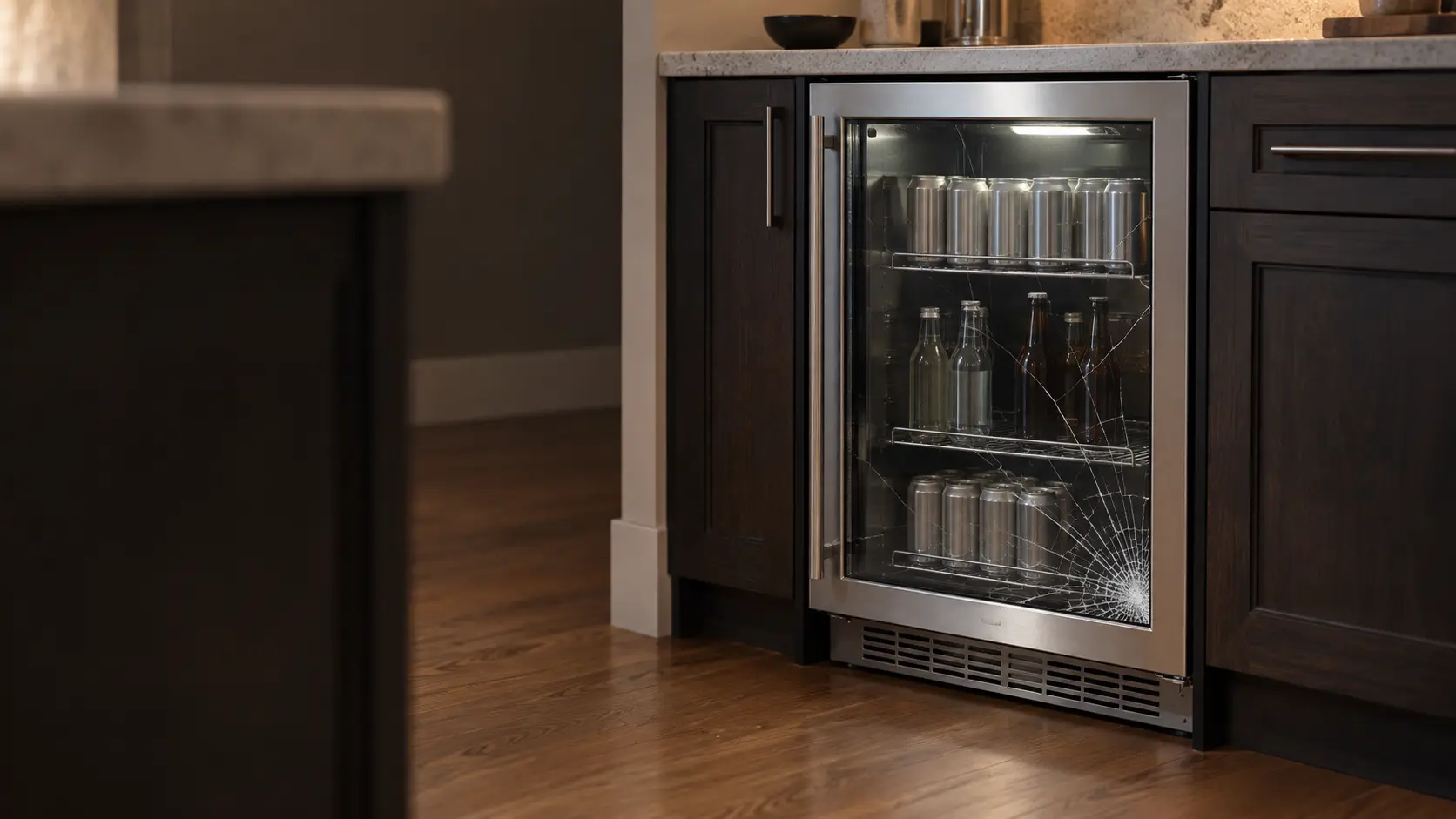
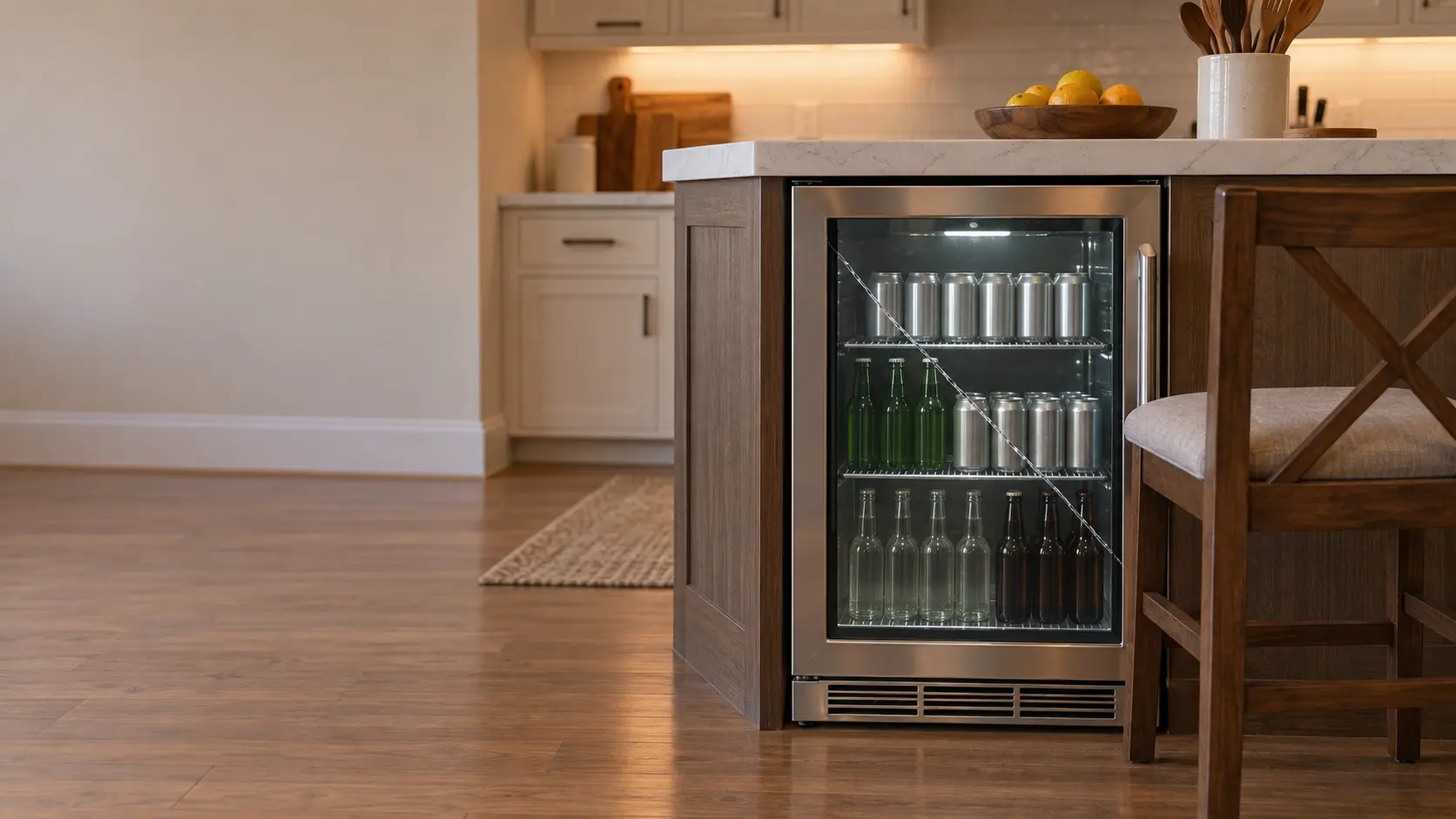
A single line, a star or a web
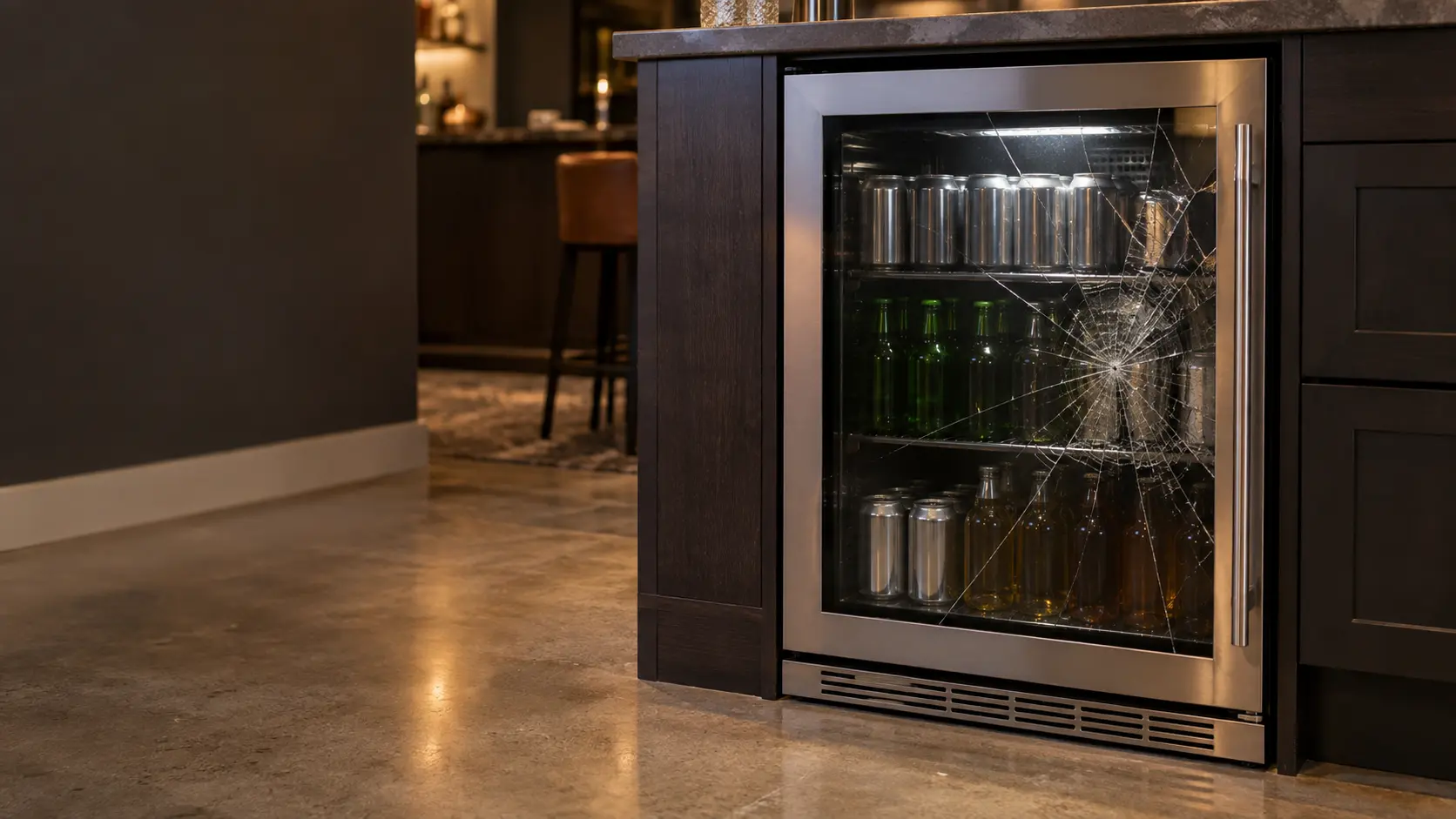
A clean line from one edge usually marks where the pane took a knock against its frame. A star with a white center points to a direct hit from a bottle or a hard object. A web of fine cracks spreading over the whole pane is the most dangerous of the three, because the glass is already holding itself together by friction.
The knocks that crack door glass
- A heavy bottle stored on its side that rolls forward against the inside of the pane.
- A shelf pulled out while the door is only half open, so the shelf edge strikes the glass.
- A door flung open with nothing to stop it before a wall, a cabinet or an island corner.
- A cooler, a folding chair or a step stool set against the front on a crowded evening.
- A door closed hard on a bottle neck sticking out past the shelf.
Source: CPSC — 16 CFR 1201.2, Safety Standard for Architectural Glazing Materials, definitions — Tempered glass is heat or chemically treated and cannot be cut or drilled afterward; when highly tempered glass fractures at any point, the entire piece breaks into small particles
What to do in the first hour
Leave the door exactly as you found it. If it is closed, keep it closed; if it is standing open, do not swing it shut to tidy up, because the hinge side of the pane takes the most stress as the door moves. Put a chair or a box in front of the unit so nobody reaches for the handle out of habit, and tell everyone in the house why it is there.
The unit can keep running. The cabinet is still insulated and sealed by its gasket even with a crack in the pane, and the drinks inside will stay cold far longer behind a shut door than in a cooler on the counter. Zephyr's manual already rules out perishable food in its beverage cooler, so there should be nothing inside that is racing a food-safety clock.
- Hands off the glass: no pressing, no tapping, no tape pulled tight across the crack.
- Children, pets and anyone barefoot out of the room until the door is replaced.
- A barrier in front of the handle so the door is not opened by reflex.
- A photo of the crack and of the whole front, for the parts order.
Source: Zephyr — Presrv Beverage Cooler Use, Care and Installation Guide (PRB24C01AG) — Do not store perishable food; never repair the unit while plugged in; disconnect power before removing doors; door reversal needs two people and moves the door switch; open the door fully before pulling shelves out
If the glass has already come down
When the pane has given way, the order changes. Put on closed shoes and work gloves before you walk over. If the outlet is in a dry spot and you can reach it without stepping on glass, unplug the unit; if the plug sits behind the cabinet, switch off its breaker instead. Zephyr's manual tells owners never to work on the unit while it is plugged in, and the door switch, the lock and the light wiring are all near the broken edge.
Pick up the larger pieces by hand into a cardboard box, then vacuum the floor with the bare hose rather than a brush head, which can fling small pieces across the room. Pieces roll a long way on tile, so run the hose along the toe-kick grille and under the neighboring cabinets as well.
Cans and bottles that were behind the glass
Lift the drinks out one at a time with gloves on and rinse each can or bottle under the tap before it goes into another cooler; small pieces cling to condensation on cold metal and glass. Leave the shelves in place for the technician rather than pulling them out through the empty door frame, where sharp remnants often stay caught in the gasket channel.
Source: Zephyr — Presrv Beverage Cooler Use, Care and Installation Guide (PRB24C01AG) — Do not store perishable food; never repair the unit while plugged in; disconnect power before removing doors; door reversal needs two people and moves the door switch; open the door fully before pulling shelves out
What the repair usually involves
The fix is almost always a new door rather than a new pane. On U-Line's parts list for its 24-inch glass-door beverage center, the door appears as one part with its hinges, and most makers supply glass doors the same way: glass, frame, gasket and hardware as one assembly. The model and serial number decide which door fits, including which side it hinges on, so have them ready when you book.
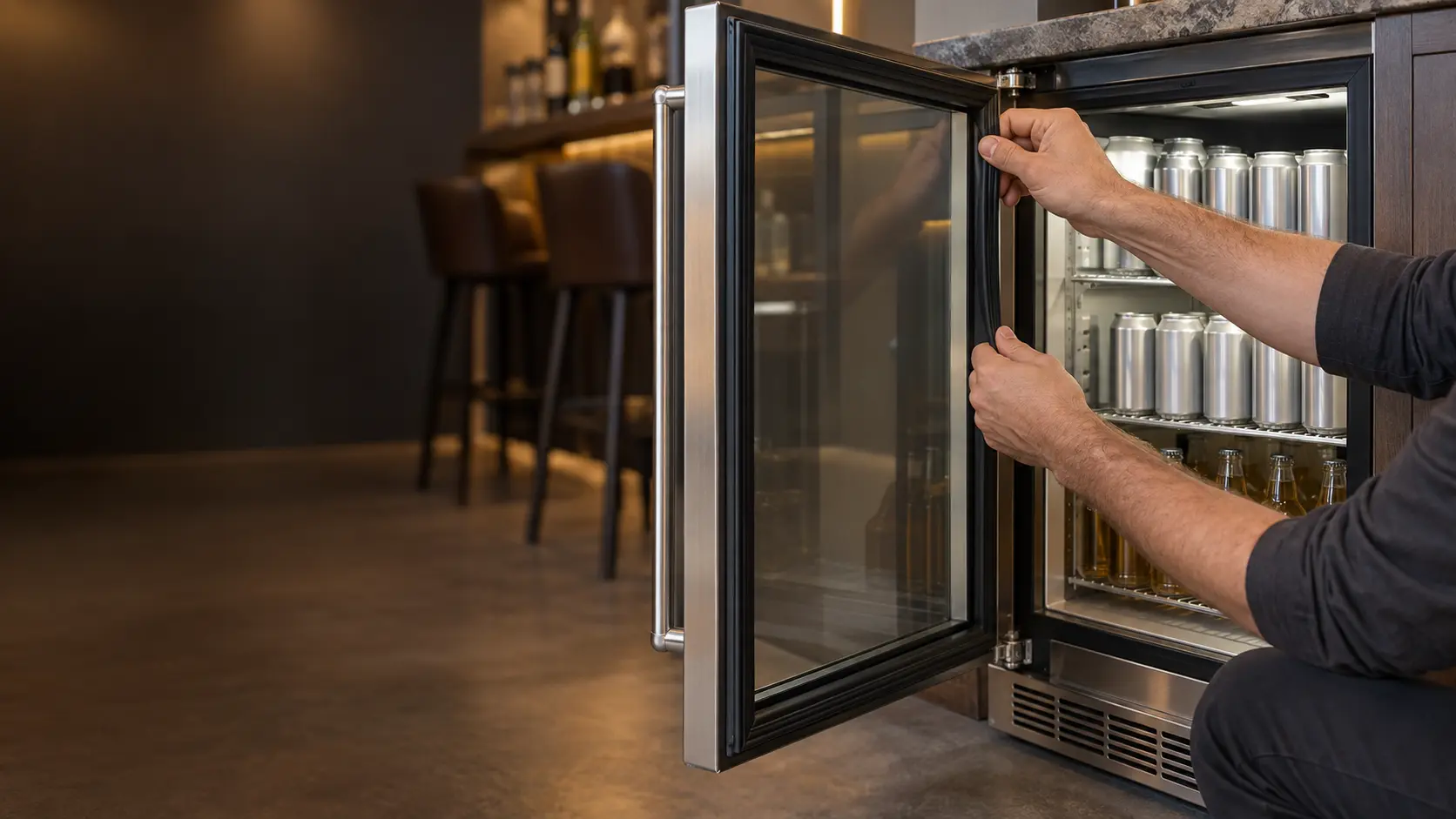
Removing a damaged door is not a job to improvise. Zephyr and U-Line both say to disconnect power before a door comes off, Zephyr asks for two people for any door work, and True's installation guide tells installers to lay a glass door flat on cardboard and take care not to damage the glass. A door that is already cracked adds the risk of the pane letting go in someone's hands while the hinge screws come out.
Lock, light switch and hinge side
A beverage center door is more than glass. Many carry a lock, and many close against a small switch that turns the interior light off; Zephyr's door-reversal steps include moving that switch to the other side. The replacement has to match the hinge side your kitchen needs and the switch your cabinet has, or the light stays on and warms the top shelf.
A wood panel is not a patch
Covering the crack with a cabinet panel sounds like a tidy answer, and True warns against it in plain terms: never mount a solid panel on a glass door, because moisture can form behind the panel and cause damage. A cracked door stays a cracked door until it is replaced.
Source: U-Line — UHBV124 Beverage Center User Guide and Service Manual — The parts list shows the glass door as one part with its hinges; Zephyr — Presrv Beverage Cooler Use, Care and Installation Guide (PRB24C01AG) — Do not store perishable food; never repair the unit while plugged in; disconnect power before removing doors; door reversal needs two people and moves the door switch; open the door fully before pulling shelves out; True Residential — 15 and 24 inch Undercounter Installation Guide — Lay a removed glass door on cardboard and take care not to damage the glass; never install a solid panel on a glass door because moisture can form behind it; optional door stop limits opening to about 120 degrees
Keeping the next door in one piece
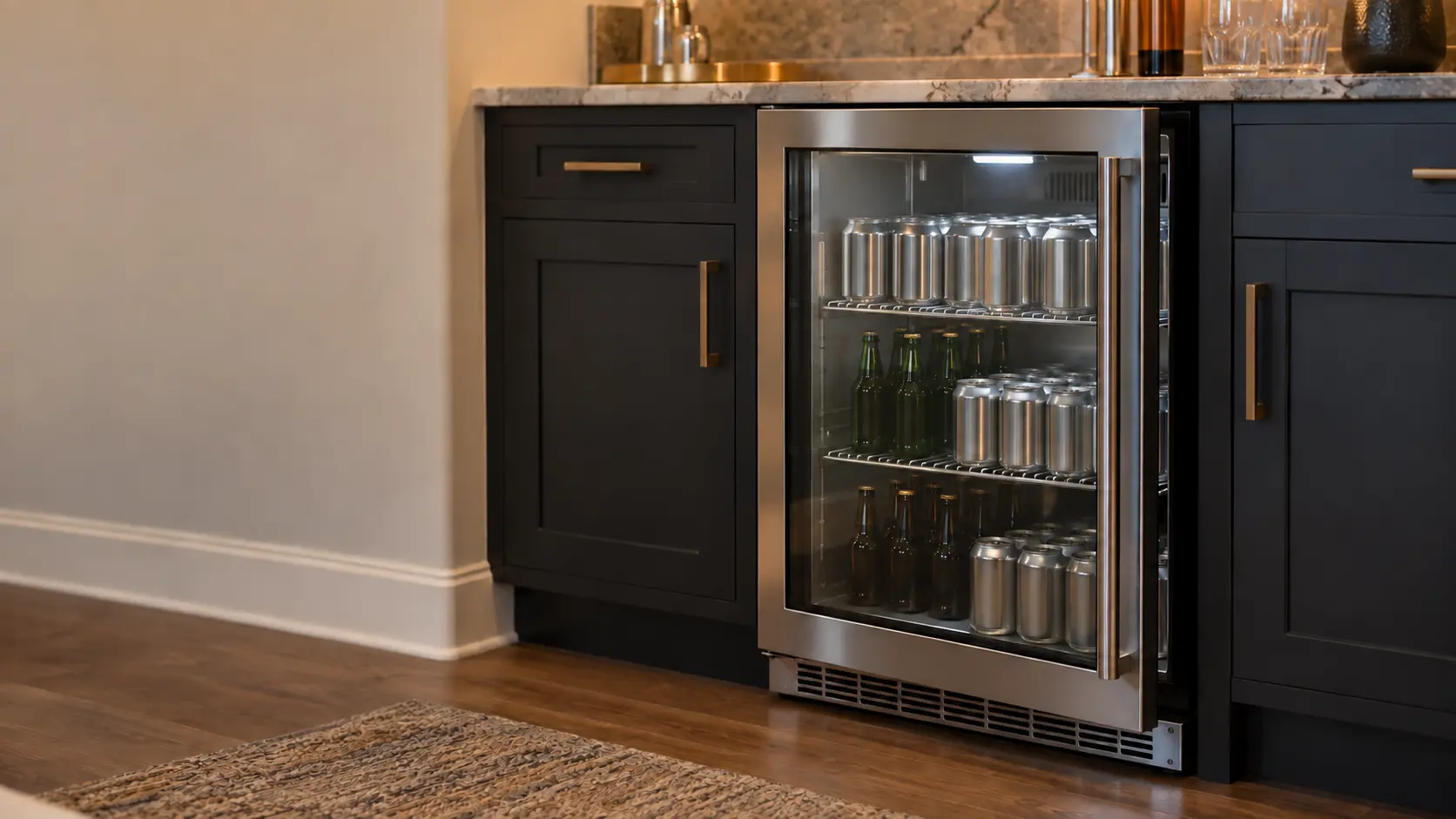
Most of the knocks that crack door glass can be designed out. Perlick's doors open to 115 degrees and the maker supplies a 90-degree hinge pin for units next to a wall or thick panel; True includes an optional door stop that holds its door to roughly 120 degrees. Either one keeps the corner of the glass off the wall.
Inside, load heavy bottles low and upright, keep anything round from rolling toward the front, and open the door fully before sliding a shelf out, which Zephyr also recommends to protect the gasket.
Source: Zephyr — Presrv Beverage Cooler Use, Care and Installation Guide (PRB24C01AG) — Do not store perishable food; never repair the unit while plugged in; disconnect power before removing doors; door reversal needs two people and moves the door switch; open the door fully before pulling shelves out; True Residential — 15 and 24 inch Undercounter Installation Guide — Lay a removed glass door on cardboard and take care not to damage the glass; never install a solid panel on a glass door because moisture can form behind it; optional door stop limits opening to about 120 degrees; Perlick — G5 Installation and Operation Manual — Doors open to 115 degrees; a 90-degree hinge stop pin is used next to a wall or with thick panels