


beverage center repair specialists
Drinks cold.
Glass clear.
Back in service.
Repairs for the unit that keeps the drinks ready to pour.
Tell us what it is doing. We’ll trace the cause.
- Compressors, fans and sensors
- Glass doors, seals, locks and drawers
- Undercounter, freestanding, outdoor
What to expect
Experienced technicians
More than 12 years in appliance repair
Upfront pricing
The cost of the repair in writing, before any work begins
OEM parts on order
Original manufacturer parts ordered against your model number, never third-party substitutes
Warranty on our workmanship
Every repair is backed by a warranty on the work we performed
Your next step
to a working beverage center.
A few details now.
A little less to worry about.
Say what the unit is doing
Choose the beverage center and tell us what the cans, the glass door, a drawer or the display are doing.
Choose a date
A calendar day, then a morning or an afternoon.
Tell us where
The street address, and a phone the technician can ring from the road.
Every beverage center carries a small plate with its brand and model. On a glass-door unit it is usually on a side wall inside the cabinet or up near the light, on some built-in models behind the front grille at the toe kick, and on a beverage drawer on the frame once the top drawer is pulled out. With it we know the exact unit before we come.
or call (844) 456-5057
Loading appointment form…
The appointment form couldn’t load. Please try again.
Four steps,
and no surprises.
The three steps in the form are how you book. These four are what actually happens once a technician is standing in your home.
Temperatures read at the shelves
A probe goes between the cans and another in front of the grille; then the compressor and both fans are heard out, and the gasket, the hinges or the drawer slides get looked over with the unit running.
The price before the work
You hear what is wrong and what it costs to fix in one conversation, then decide. When a new unit would make more sense, the technician tells you so.
Common parts in the van
The van usually holds sensors, small fan motors, relays, common gaskets and hinge pieces. A compressor, a control board, a glass door or a drawer slide is specific to its model and gets ordered; a model number sent with the booking lets us place that order before the visit.
Cold again before we go
Once the part is fitted, we watch the compressor kick on and the fans spin, see the cabinet air falling toward the setting, and tell you when the shelves can be loaded again.
Not every beverage center
breaks the same way.
An undercounter beverage center tucks under the counter and breathes only through a grille at the toe kick, a freestanding beverage cooler stands on its own with space around it, an outdoor-rated unit is built for a covered patio in heat and damp air, and a beverage drawer slides out of the cabinetry like any other drawer. Which one holds your sodas?
All beverage center types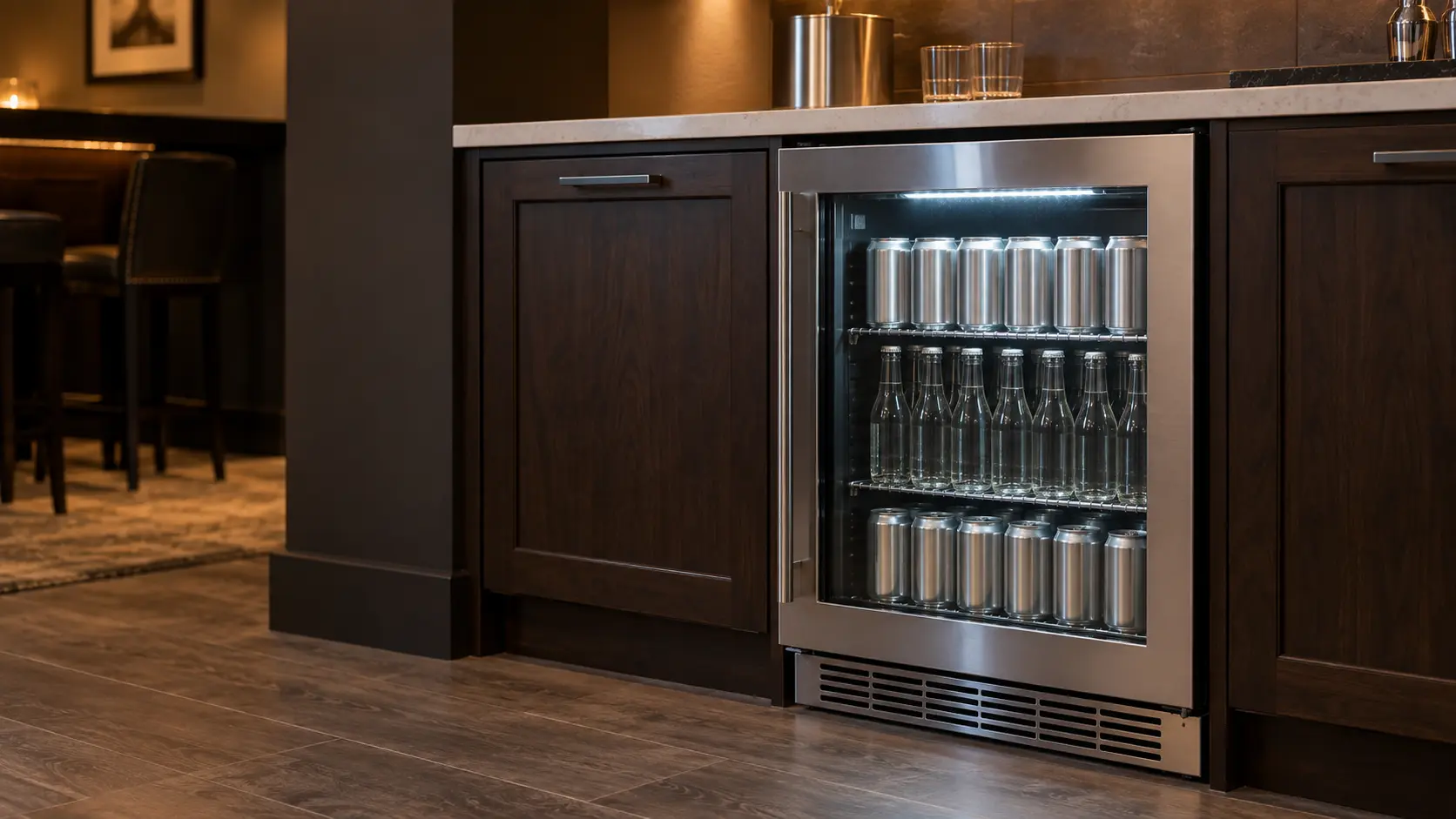
Undercounter beverage center
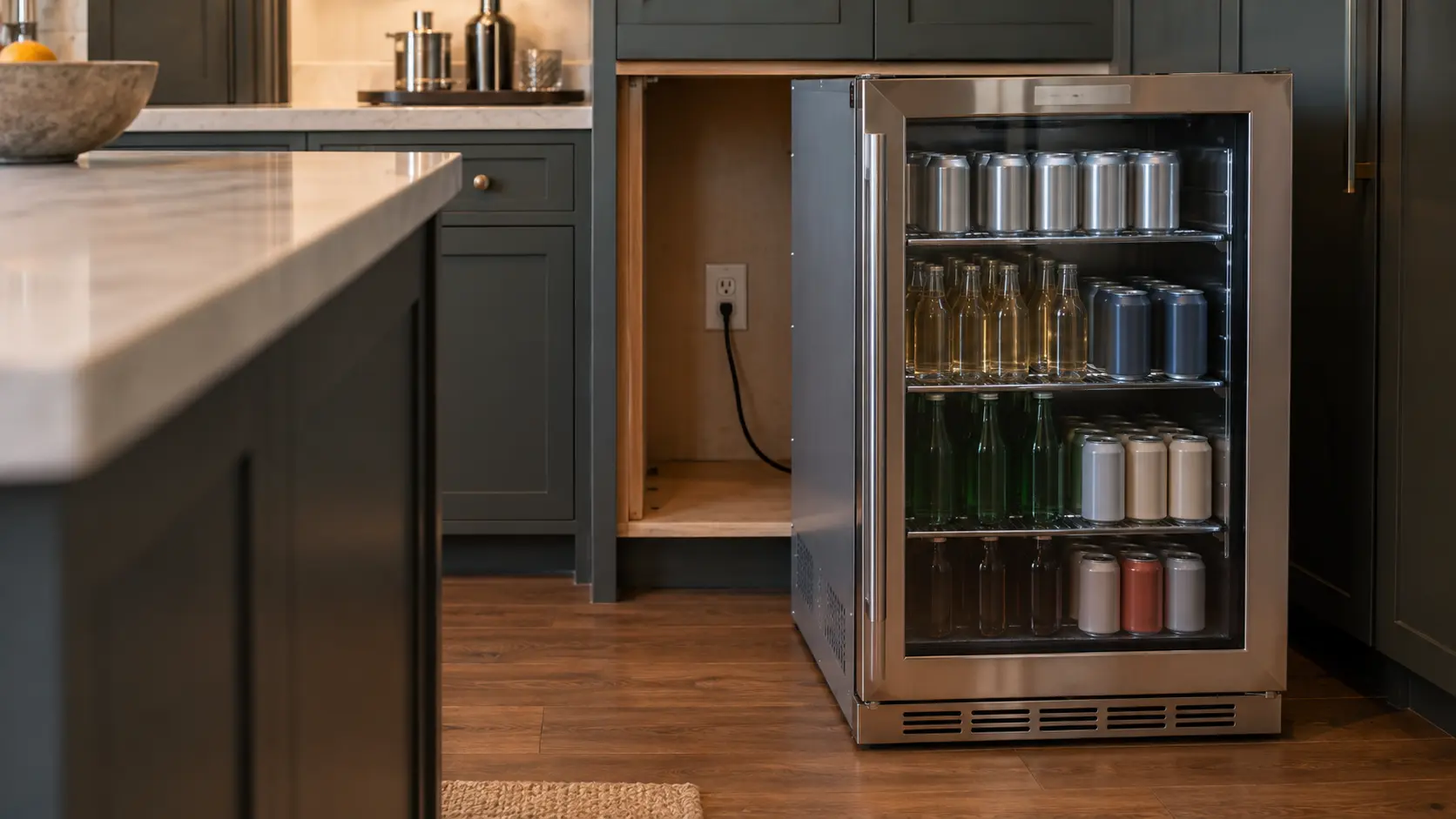
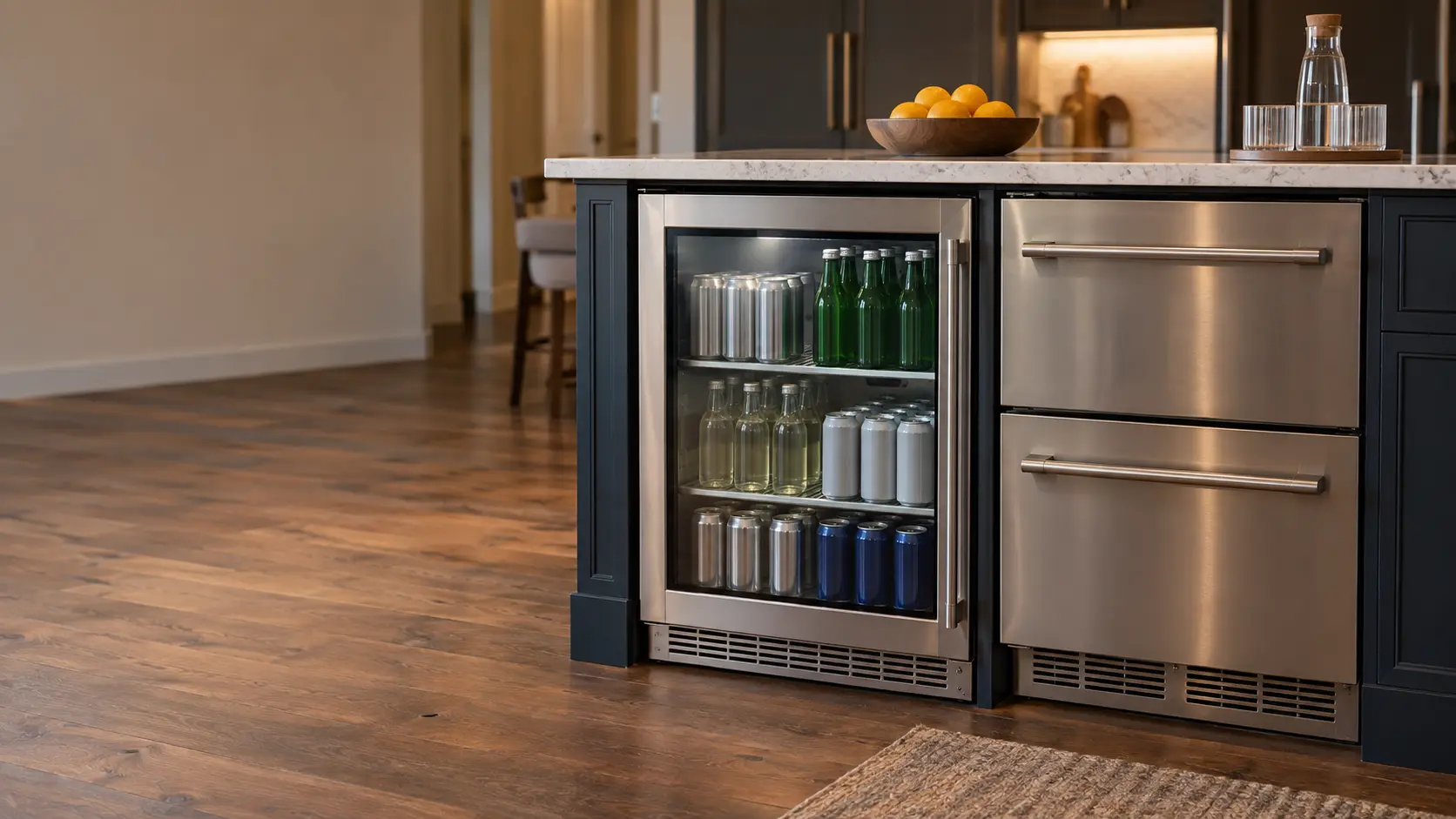
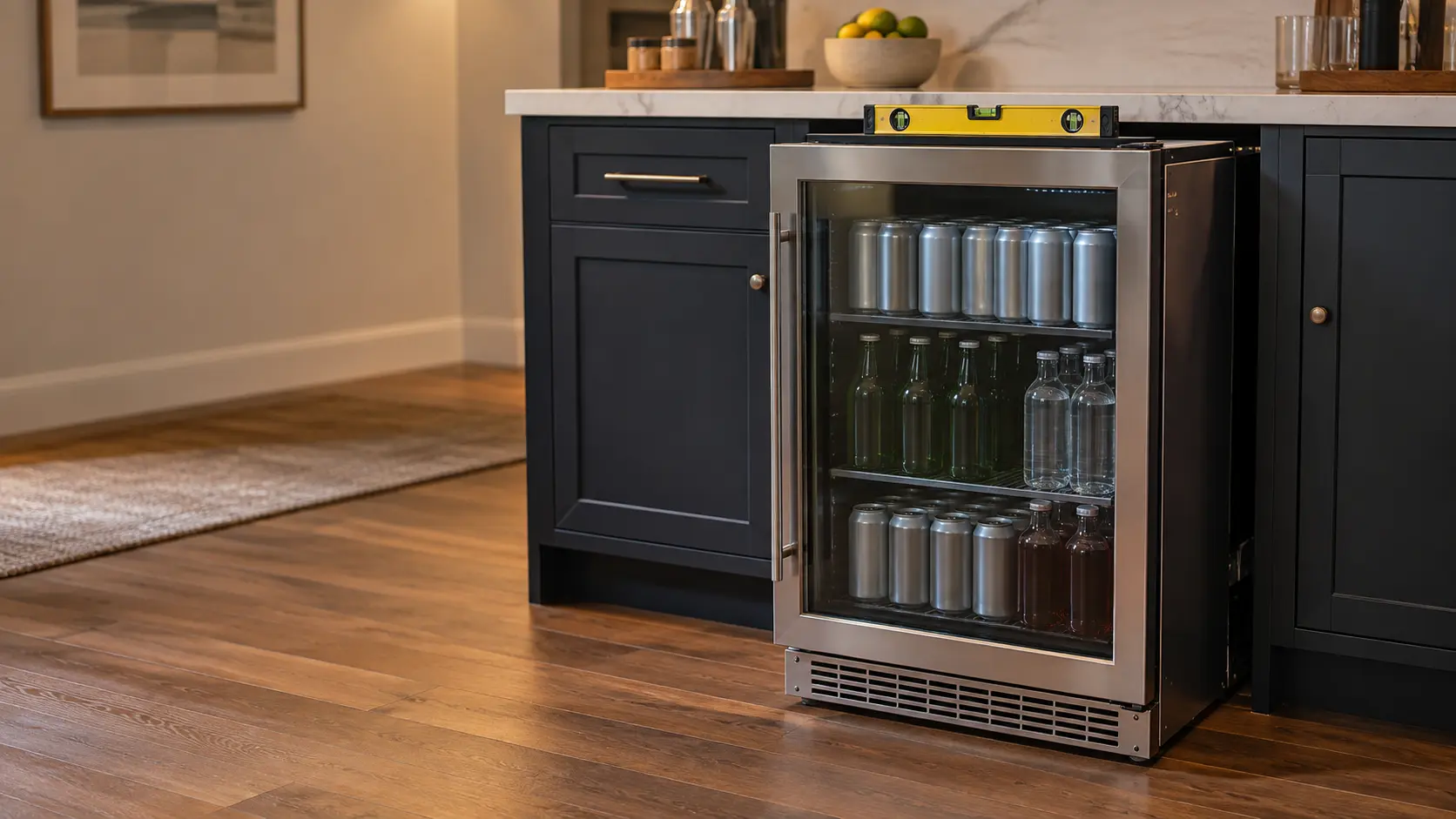
A glass-door cabinet for cans and bottles, set in under a counter in a wet bar, a basement bar, a game room or at the end of a kitchen island, and breathing only through the grille at its toe kick.
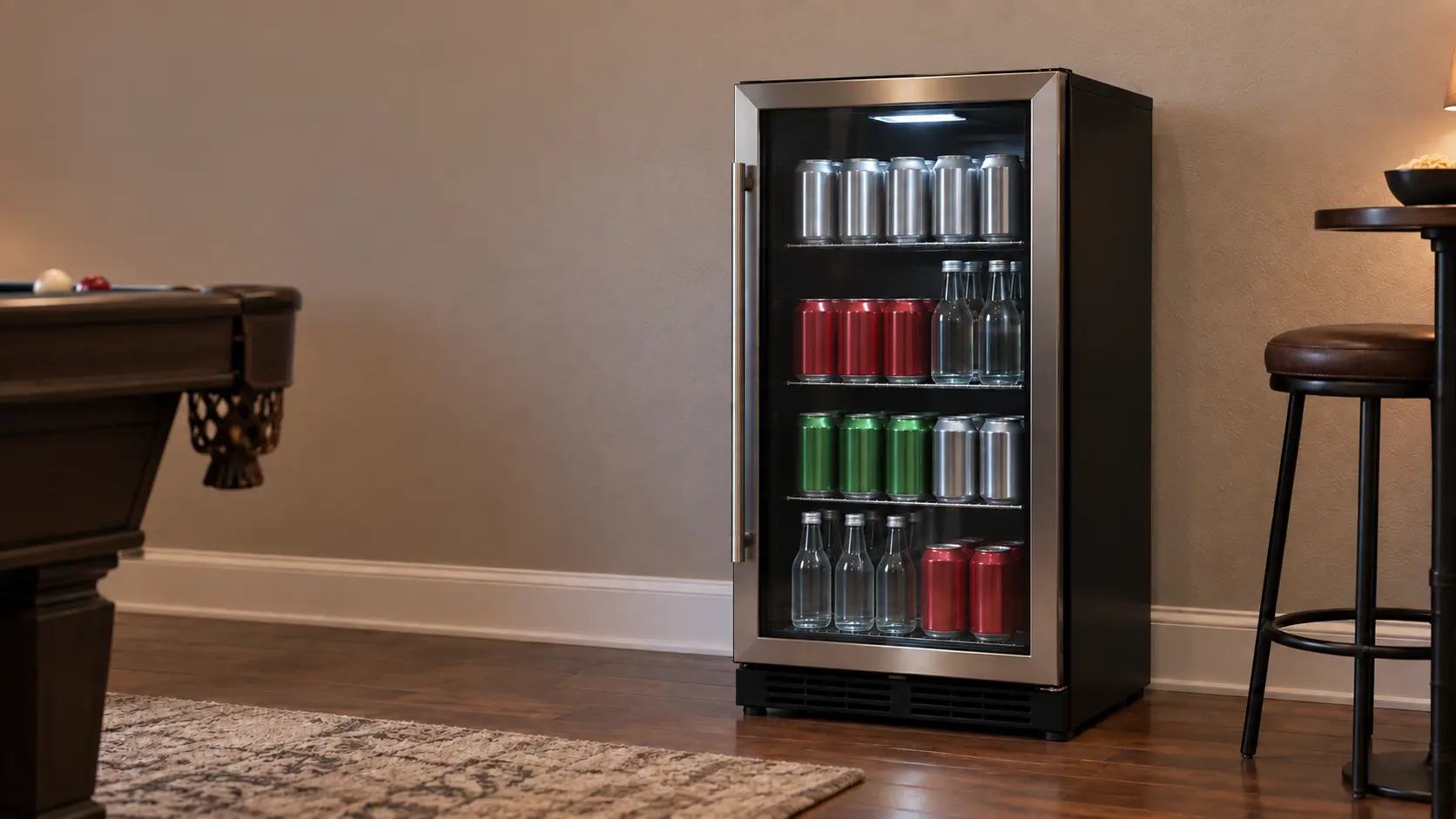
Freestanding beverage cooler
A glass-door beverage cooler that stands on its own against a wall, in a game room, a home office, a garage or on a counter, and sheds heat through its back or sides rather than a front grille.
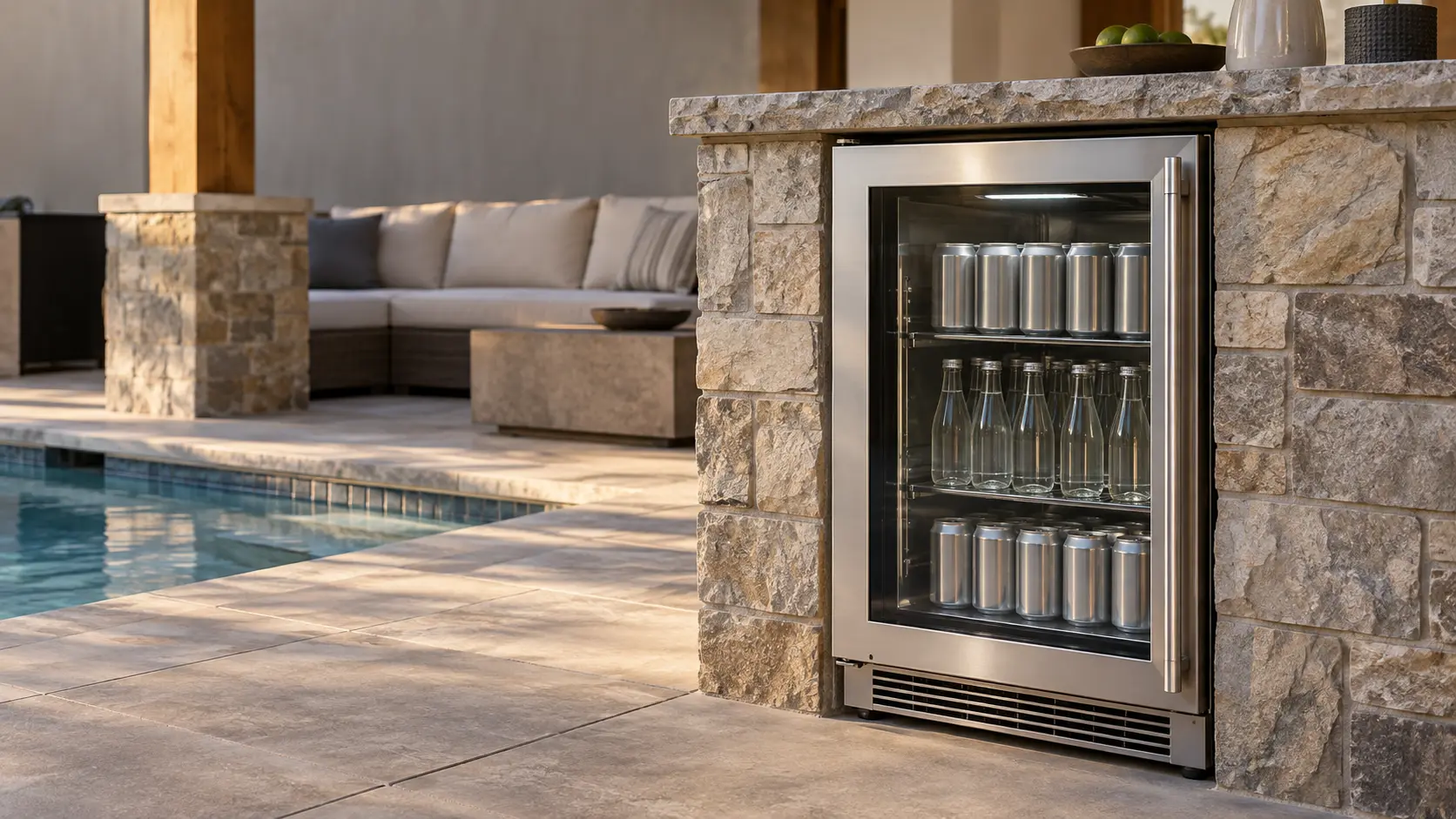
Outdoor beverage center
A beverage center rated by its maker for outdoor use, built under a covered patio counter or a poolside bar, sealed against weather and plugged into a GFCI-protected outlet.
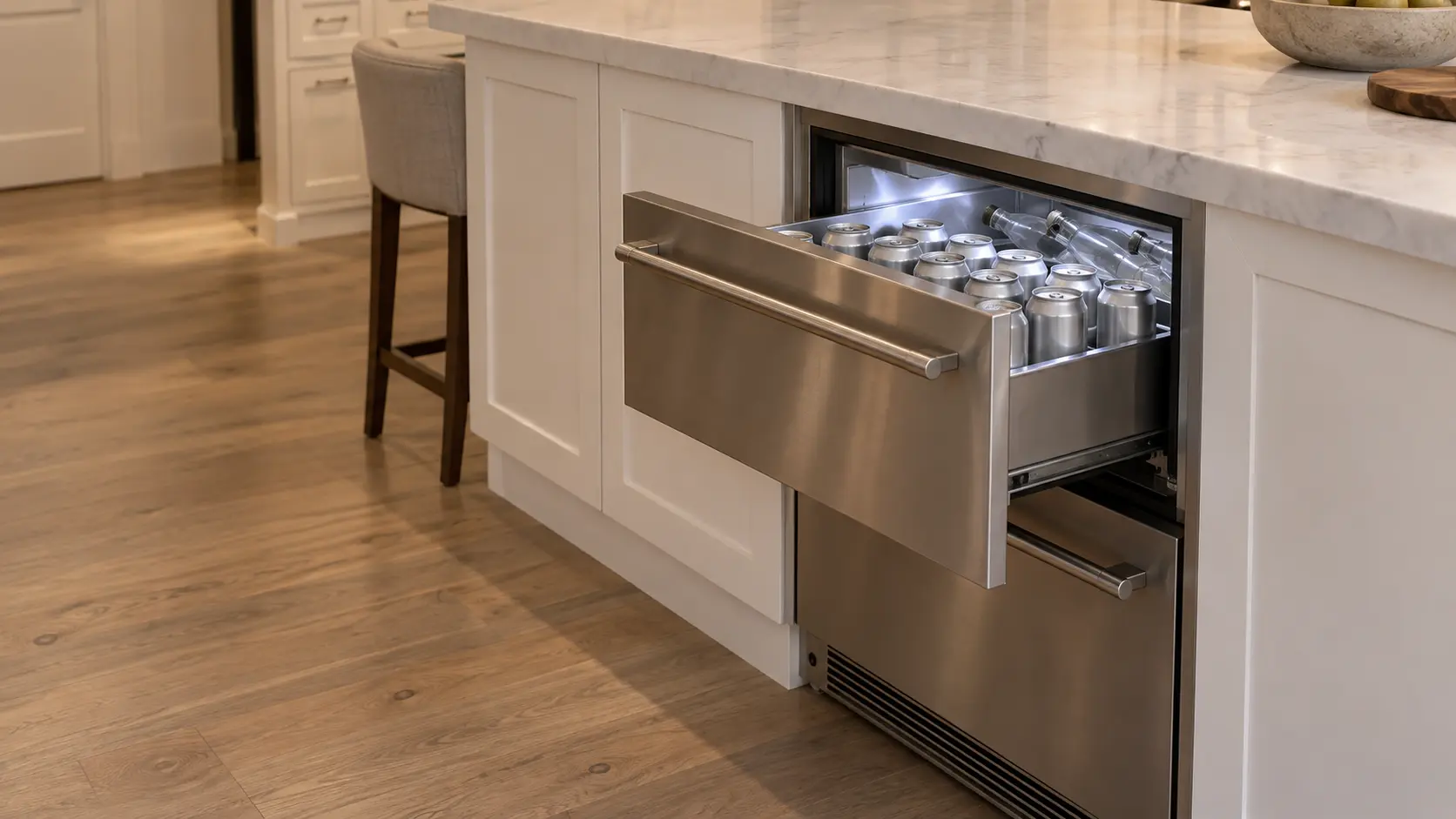
Beverage drawers
Refrigerated drawers that pull straight out of a kitchen island, a bar or a pantry cabinet, loaded from above with cans and bottles, each riding on full-extension slides behind its own seal.
Every kind we serviceAll beverage centers, side by side
The archive puts the 4 types against each other: how to tell which you own, what fails on each, and which manufacturers build them.
How to tell yoursWhat fails on eachWho makes them Open the type archiveA can that is cold, not frozen.
A door that seals and stays clear.
Maybe the sodas come out barely cool, a can split open on the back shelf overnight, the glass door fogs every humid afternoon, or the unit under the patio counter gives up once the sun reaches it. Start with the last thing you noticed; each page begins with what that sign usually points to and leaves the booking for the end.
 All 17 problems
Water Pooling Under a Beverage Center
A beverage center leaking water usually shows up as a wet strip along the toe-kick grille, a damp patch on the cabinet floor under the bottom shelf, or a sticky trail where a can gave way and its contents found the floor.
Beverage Center Smells Like Something Is Burning
A beverage center burning smell can be sharp like hot plastic, dusty like a space heater switched on after summer, or acrid like scorched wiring, and it tends to be strongest at the grille by the floor where the machine breathes.
Breaker or GFCI Cuts Power to the Beverage Center
A beverage center tripping breaker or GFCI outlet goes dark without warning: the light is out, the hum has stopped, the test button on the outlet has popped, and the cans are slowly warming behind the glass.
Cracked or Shattered Beverage Center Glass Door
A beverage center glass door cracked across one pane, crazed into a web of lines, or burst into small pebbles on the floor is a safety problem first: tempered glass that has cracked can let go all at once.
Beverage Center Not Cooling the Cans
A beverage center not cooling hands you a can that feels no colder than the pantry, a bottle that sweats only a little, and a cabinet that is quiet or humming along while the display still shows the number you picked.
Beverage Center Won't Power Up
A beverage center not turning on is completely dark and silent: no interior light when the door opens, a blank panel, no hum, and cans that are warming at room pace.
Familiar brands. Expert care.
For the brands
in your home.
Independent repair service. Not affiliated with, authorized or endorsed by any manufacturer. Brand names and model numbers are the property of their respective owners and are used here for identification only, to describe the appliances we service.
What a repair
usually costs.
Weigh a repair against a new unit for the same opening, including the carpentry, the panels or the stonework that holds it. Seals, hinges, drains, lights, fans and sensors are small against that figure, and so are most outdoor weather repairs. Built-in, drawer and outdoor units nearly always earn their repair, sealed-system work included, since a replacement has to fit the cutout and match its surroundings. On a small, older freestanding cooler the line is a failed compressor, a leak or a dead thermoelectric module, and there the technician puts both numbers in front of you.
| Repair | Relative cost | Notes |
|---|---|---|
| Start relay, compressor or refrigerant leak | moderate to highest | A start relay or overload clipped to the compressor is a small part reached behind the toe grille or the back cover. Opening the loop to braze a leak, then a fresh drier, evacuation and a charge by weight, or a replacement compressor, lands near the top of the scale. |
| Evaporator or condenser fan motor | low to moderate | Either fan is an affordable motor, reached through the back wall of the cabinet or behind the grille. Thawing a coil that iced over around a stopped fan, or cleaning a condenser packed with patio debris, adds a little time. |
| Thermostat or temperature sensor | low to moderate | A dial thermostat or a clip-on sensor is an inexpensive part. A drawer unit with a sensor in each drawer, where more than one has drifted, or a separate defrost sensor, moves the job up a step. |
| Control board, touch display or keypad | moderate to highest | A connector, a door switch or a fuse on the board is a small repair. A main board or a touch display for a built-in or outdoor model is one of the dearest parts the unit takes, and some are ordered in from the maker. |
| Door seal, hinge or full glass door | low to moderate | A seal made for the model and a squared or new hinge sit low on the scale. A full glass door, needed when the pane fogs between its layers or cracks, costs a clear step more than a seal alone. |
| Interior light, LED driver, door switch or lock | low | LED strips, door switches and cam locks are inexpensive, and each goes in with a screwdriver and the part matched to the model. A driver board, or a lock that needs a new strike on the cabinet as well, sits a little higher. |
| Drain hole, drain tube or drain pan | lowest | Clearing a drain clogged with sugar or a cap and flushing it through to the pan is among the least costly work on a beverage center. A cracked pan that has to be reached by drawing a built-in unit out of its opening adds some. |
| Outdoor weather damage, GFCI trips and corrosion | moderate | Cleaning a choked condenser and tracing a damp cord connection sit toward the low end. Replacing weathered seals, rusted hinge hardware or a part that has taken on water, on a unit built into stonework, brings the job to the middle of the scale. |
| Drawer slides, drawer seal or drawer front | low to moderate | A slide, a seal or new mounting hardware for one drawer is a modest set of parts fitted with hand tools. Both drawers needing slides, or paneled fronts that have to come off and go back on, add time. |
9 metros,
one appliance.
Where a beverage center stands sets how hard it works: a covered patio that bakes all afternoon, a basement bar that stays damp, a coastal home where salt air eats at an outdoor unit, a game room crowded on weekends, a condo kitchen where the unit is boxed into tight cabinets. The notes are about the units in each town and the conditions they run in, not a tour of the town.
All service areasTampa BayFL · 31 areas
Houses around Tampa Bay rarely have basements, so beverage centers stand in kitchens, game rooms and covered lanai bars beside the pool, many of them outdoor-rated. The 2024 hurricanes pushed surge into coastal homes and left them dark for days, summer afternoons bring lightning, and damp air beads on any glass door that has stopped sealing.
OrlandoFL · 30 areas
In Orlando a beverage center may serve a lakeside patio, a family kitchen or the game room of a vacation rental where every new guest tries the buttons. Summer thunderstorms flicker the power most afternoons, and Hurricanes Ian in 2022 and Milton in 2024 cut it for days.
Miami / South FloridaFL · 47 areas
South Florida beverage centers live with heat, humidity and salt: pool decks and lanais hold outdoor units, tower wet bars hold undercounter ones, and damp air fogs every glass door that loses its seal. Hurricanes can leave them dark for days, and many owners spend the summer elsewhere.
New York MetroNY · 75 areas
New York beverage centers are mostly undercounter units in apartment kitchens, with basement bars in brownstones and a few outdoor units on rooftops and terraces. Radiators and summer heat waves work against cold cans, rooftop units must be shut down before winter, and narrow stairs and small elevators make repair the usual choice.
HoustonTX · 36 areas
Houston beverage centers work in game rooms, kitchen islands and covered patios where heat and humidity rarely let up from April to October, and outdoor units there run close to their limits. Hurricane Beryl in 2024 and the winter storm of February 2021 left homes without power for days, and low-lying streets flood into ground-floor bars.
ChicagoIL · 50 areas
Chicagoland beverage centers live in kitchens, in basement bars and, from spring to fall only, on patios. Cold basements slow them in winter, dry heat hardens their gaskets, humid summers load the drains, and outdoor units left running through a freeze burst their cans.
Los AngelesCA · 95 areas
Los Angeles beverage centers live in mild beach kitchens and in Valley family rooms and patios that pass 100 degrees, and many are outdoor units set into patio islands. The region is a seismic zone that can knock a built-in door out of line, fire-season shutoffs stop units for days, and ash from the 2025 fires still turns up in condenser coils.
San DiegoCA · 31 areas
Near the San Diego shore kitchens stay mild enough that an undercounter beverage center barely works, while patios in the inland valleys bake through September and October and push outdoor units hard. Salt air pits hinges and drawer slides by the beach, and power shutoffs return in fire weather.
San Francisco Bay AreaCA · 74 areas
Bay Area beverage centers sit in kitchens and home bars that often lack air conditioning, in Peninsula remodels with drawers in the island, and on decks where fog and sun trade places through the day. Public-safety power shutoffs in fire weather stop them for days, and an earthquake can knock a built-in door out of line.

Answers before
you book.
What is the earliest a technician can see my beverage center?
Do you repair the kind of beverage center I have?
How do I get ready for the beverage center appointment?
How much does a beverage center repair usually cost?
My beverage center is several years old. Is it still worth repairing?
Cans froze and burst inside the unit. What comes first?
Work out what
you are dealing with.
Split by what you are trying to find out rather than by what part of the appliance it concerns.
All 23 guides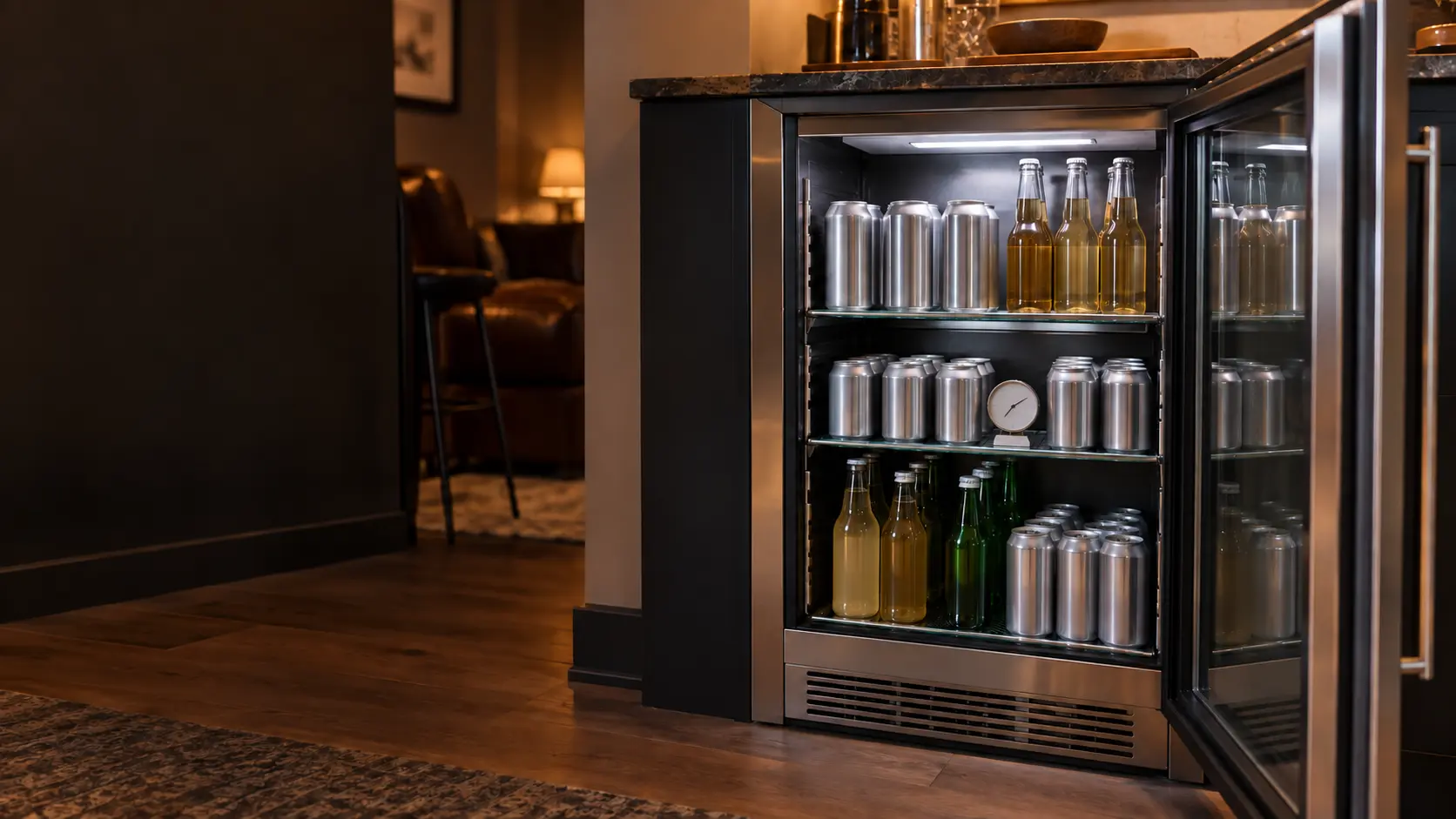
Wondering what the repair might run? That answer has its own page, because a fair figure only exists once the unit has been measured running — beverage center repair cost.
Back to your everyday
Let’s get your beverage center working again.
Three short steps, a window that suits you, and a price for the actual repair before any work starts.