Choosing the date
The yearly beverage center check works best just before the unit's heaviest use, when a problem found still leaves time for a part to arrive. For most homes that is late spring. For a unit that works hardest around the winter holidays, pick early November.
Outdoor units already have a natural date. Perlick recommends its spring start-up once the daily low stays at or above 42°F for beverage center models, and that start-up is the right moment for everything below.
Source: Perlick — Residential FAQs (spring start-up of outdoor products) — Spring start-up of outdoor beverage center models once the daily low is at or above 42°F
Reading the real temperature
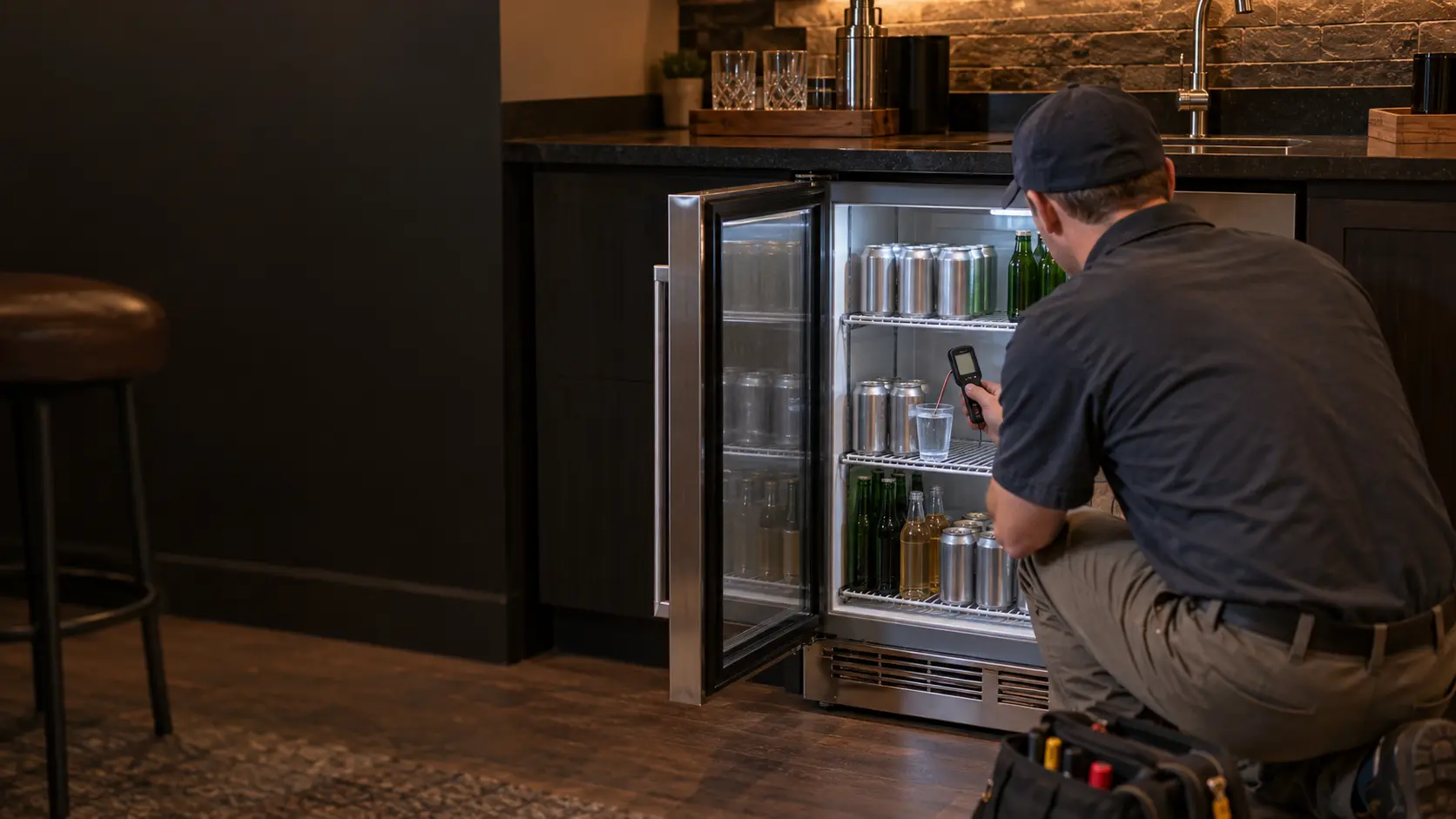
The number on the display is the air near the sensor, which changes every time the door opens. U-Line explains that air temperature does not show product temperature and describes a better test: a plastic bottle partly filled with water, an accurate thermometer inside, the cap tightened, left in place for 24 hours without opening the door.
Compare the reading with the set point. Within a couple of degrees is healthy. A reading well below the set point on a lower shelf is the early warning for split cans in winter; a reading well above it at the top is often the interior light or a busy door.
Setting the number
Zephyr's beverage cooler, for one, can be set from 34°F to 50°F. Around 36°F keeps cans cold while leaving a margin above freezing; if you store wine in a second zone, that zone belongs to wine storage rules, which our sister site covers.
Source: U-Line — 24" beverage center user guide (UHBV124) — Air temperature does not indicate product temperature; check with a thermometer in a capped water bottle for 24 hours; minor frost normal, manually defrost at 1/4 inch; no sharp instruments or heaters

The door, the gasket and the hinges
A year of evenings loosens hinge screws and flattens the busiest corner of a gasket. Open and close the door slowly and watch whether it falls shut on its own, meets the cabinet evenly and does not rub the counter above. Wash the gasket folds, which collect the year's spilled soda.
While the door is open, look at the shelves as well. Wire racks with a bent rail or glass shelves with a chipped edge catch cans on the way out, and a shelf that sits crooked blocks the air that should reach the lower rows.
- The door closes by itself from half open.
- The gasket touches the cabinet all the way round, with no pinched fold at the hinge side.
- The lock turns freely and the spare key is where you think it is.
- The interior light goes off when the door closes; a light left on warms the top shelf.
Air, frost and the filter
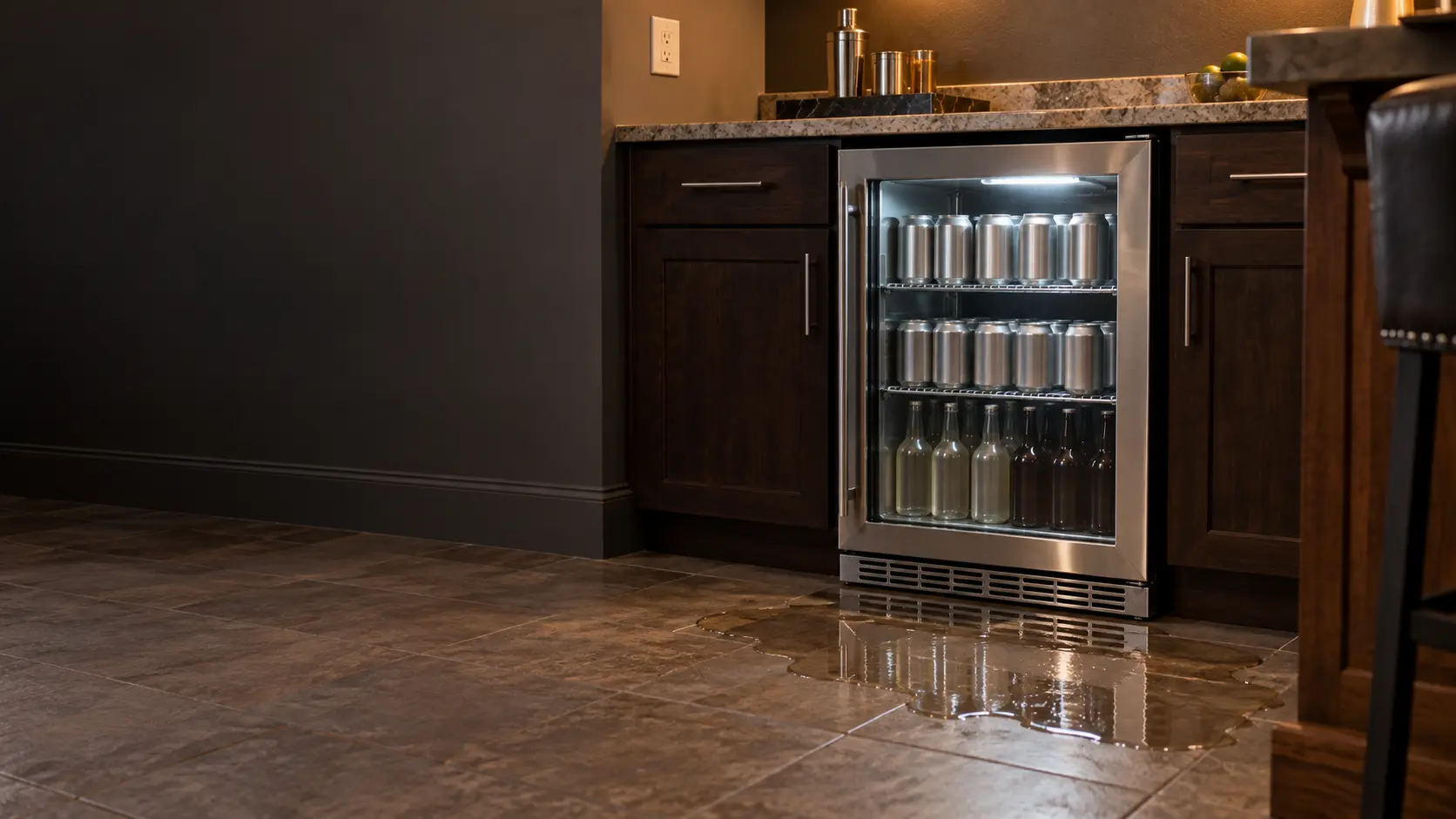
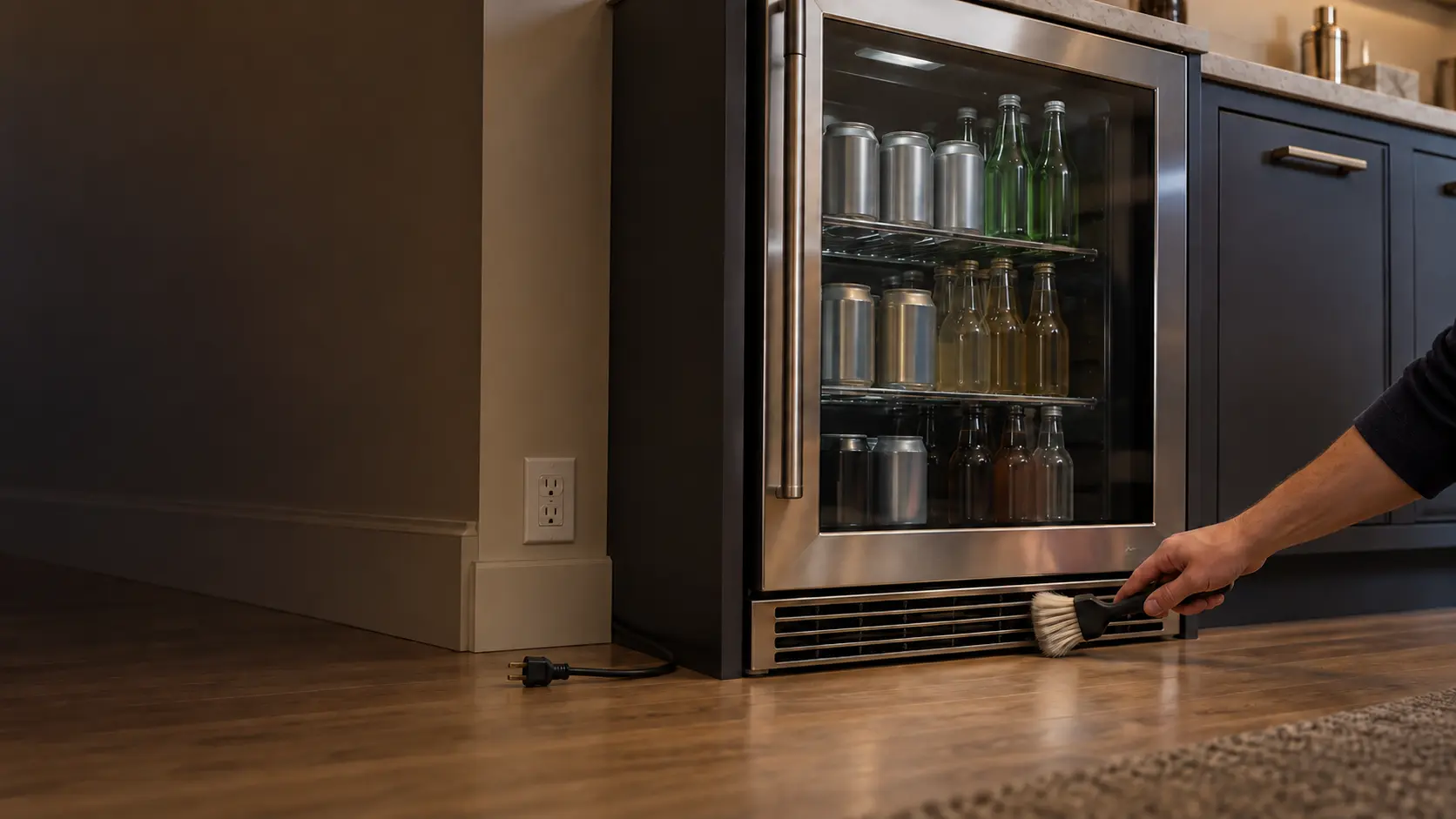
Take off the front grille and clean the condenser with a vacuum or soft brush, with the power off; the maintenance guide on that job has the full routine. While the grille is off, look for water under the unit or rust on the base, both of which deserve a closer look.
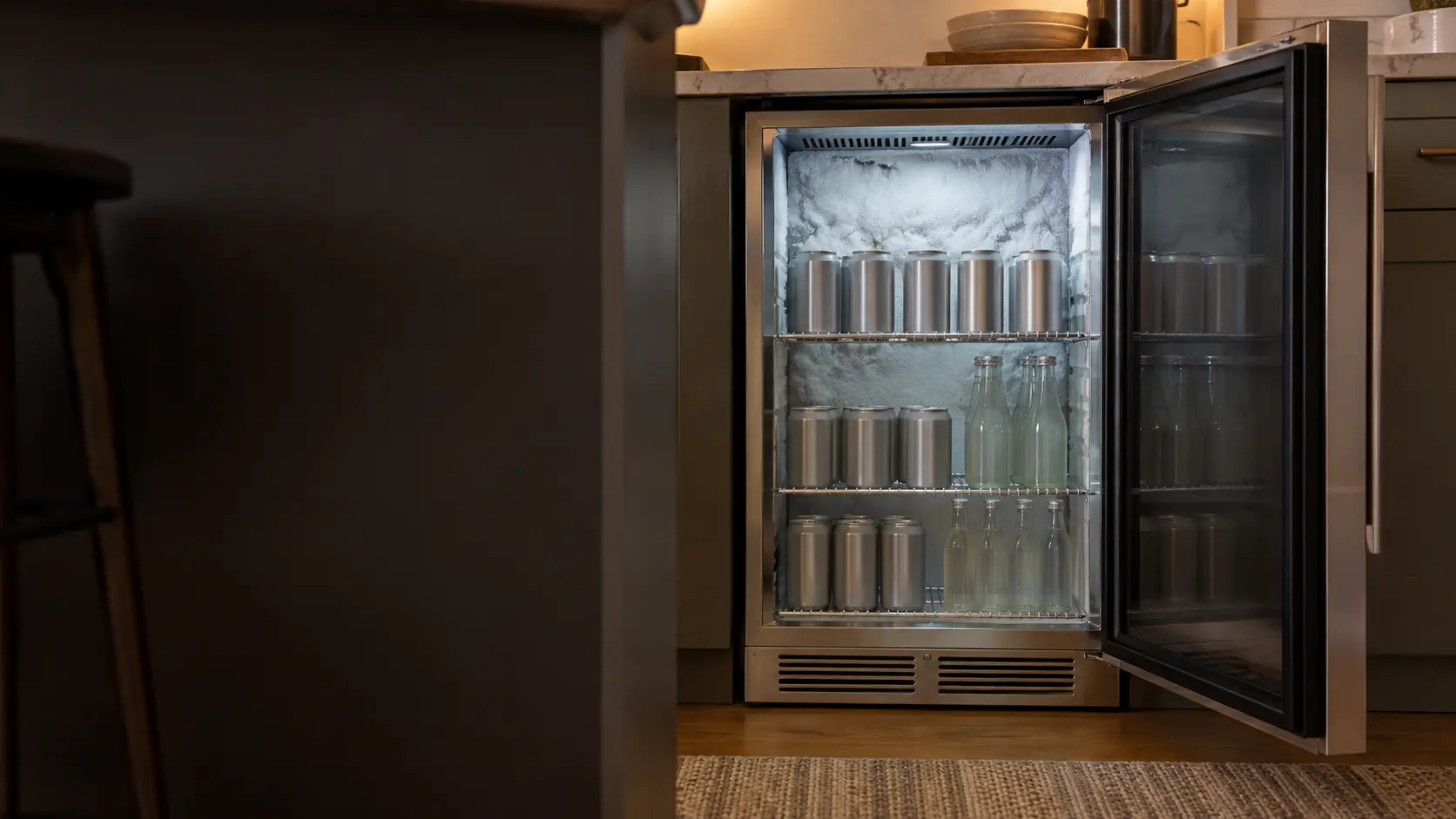
Inside, check the back wall. U-Line calls light frost that melts each off cycle normal and suggests a manual defrost once it builds to a quarter inch or more.
Defrosting safely
Switch the unit off, empty it, prop the door and let the frost melt on its own with towels below. Both U-Line and Zephyr warn against sharp tools, and U-Line also rules out heaters, which can crack the liner. Zephyr notes that full melting may take up to 24 hours.
The odor filter
Some units carry a small carbon filter in the rear wall. Zephyr asks for a new one every three to six months, and every three months in a kitchen. If yours has one, the yearly check is the day to buy a season's supply.
Source: U-Line — 24" beverage center user guide (UHBV124) — Air temperature does not indicate product temperature; check with a thermometer in a capped water bottle for 24 hours; minor frost normal, manually defrost at 1/4 inch; no sharp instruments or heaters
The model plate and a recall search
Photograph the model and serial plate, usually on an inside side wall or behind the grille, and keep the picture with the purchase record. It saves time on any future call and lets you search the Consumer Product Safety Commission's recall list by brand and model in a couple of minutes.
Write down a few lines each year and keep them with the photo. Over two or three years that short log shows a slow drift, a warmer reading each summer or a door that needs a firmer push, which no single check would reveal.
- The date and the water-bottle reading against the set point.
- Anything new: a sound, a smell, a door that needs a push, water under the unit.
- What was cleaned or replaced, such as the filter or a gasket.
- The model and serial number, copied once and kept with the receipt.
Source: US Consumer Product Safety Commission — Recalls — Federal database of consumer product recalls searchable by brand and product