Rated for outdoors, by model and serial number
The first check happens before the unit is even bought. An outdoor rating is a design decision about the cabinet, the wiring, the controls and the finish, and it belongs to specific models. Zephyr's Presrv beverage cooler manual states that the unit is for indoor use and must be protected from rain, sleet, snow and moisture. U-Line and Marvel both say their warranties apply to units operated outside only if the model and serial number were designed for outdoor use.
At the other end, True says every one of its undercounter units carries a UL rating for outdoor use. So the same glass-door cabinet shape can be perfectly suited to a patio from one maker and entirely wrong from another. Check the model page, not the catalog photo.
Coast air and pool water
Salt air and pool chemicals attack stainless steel, hinges and condenser fins. Perlick recommends its coastal-grade units within one mile of the coast, and up to five miles depending on local conditions; it also recommends them near a pool and says they are needed beside an indoor one. If the patio is on the water, ask about the grade before anything else.
Source: Zephyr — Presrv Beverage Cooler Use, Care and Installation Guide (PRB24C01AG) — The beverage cooler is for indoor use and must be protected from rain, sleet, snow and moisture; U-Line — UHBV124 Beverage Center User Guide and Service Manual — Warranties apply to units operated outside only if designed for outdoor use by model and serial number; Marvel — ML24BC Installation, Operation and Maintenance Instructions — Warranties apply to units operated outside only if designed for outdoor use by model and serial number; True Residential — 15 and 24 inch Undercounter Installation Guide — All undercounter units are UL rated for outdoor use; vent the rear of the opening where ambient regularly exceeds 95°F; install flush with the countertop covering the gasket in an opening at least 24 inches deep because gaskets are not watertight; anti-tip brackets must be installed; dedicated circuit; winterize at a steady 32°F or below with a cover; run 24 hours before use
Choosing the spot on the patio
Shade matters more than anything else you control. U-Line asks for its units to be kept out of direct sunlight and away from heat-generating equipment, and a glass door facing west takes the full afternoon sun on a pane that is only as good an insulator as its glass. Put the beverage center on the shaded side of the counter, away from the cooking station and its hot exhaust.
Heat limits are written into the manuals. Perlick lists a beverage unit's working air as 38°F to 105°F. U-Line's outdoor refrigerator manual gives 50°F to 100°F and warns that higher temperatures reduce the unit's ability to reach low settings. True recommends venting the rear of the rough opening wherever summer air regularly passes 95°F.
- Shaded side of the counter, out of the late-afternoon sun.
- Away from the cooking station, a patio heater and any exhaust.
- Not in a low spot where rain runs off the patio and pools.
- Close enough to the outlet that no extension cord is ever needed.
Source: U-Line — UORE124 Outdoor User Guide and Service Manual — Operates between 50°F and 100°F; higher ambient temperatures reduce the ability to reach low settings; keep out of direct sunlight and away from heat; winterize at 40°F or below by unplugging, cleaning, drying and leaving the door open at least 2 inches; True Residential — 15 and 24 inch Undercounter Installation Guide — All undercounter units are UL rated for outdoor use; vent the rear of the opening where ambient regularly exceeds 95°F; install flush with the countertop covering the gasket in an opening at least 24 inches deep because gaskets are not watertight; anti-tip brackets must be installed; dedicated circuit; winterize at a steady 32°F or below with a cover; run 24 hours before use; Perlick — G5 Installation and Operation Manual — Coastal grade within 1 mile of the coast, up to 5 miles, and near pools; beverage ambient 38°F to 105°F; support and shim the countertop, no heavy objects above; floor level with the finished floor; anti-tip bracket and concrete fasteners; do not cover the unit; spring start-up runs 24 hours; clean the condenser every 30 days; wait 24 hours after tilting past 45 degrees

The counter, the cutout and the overhang
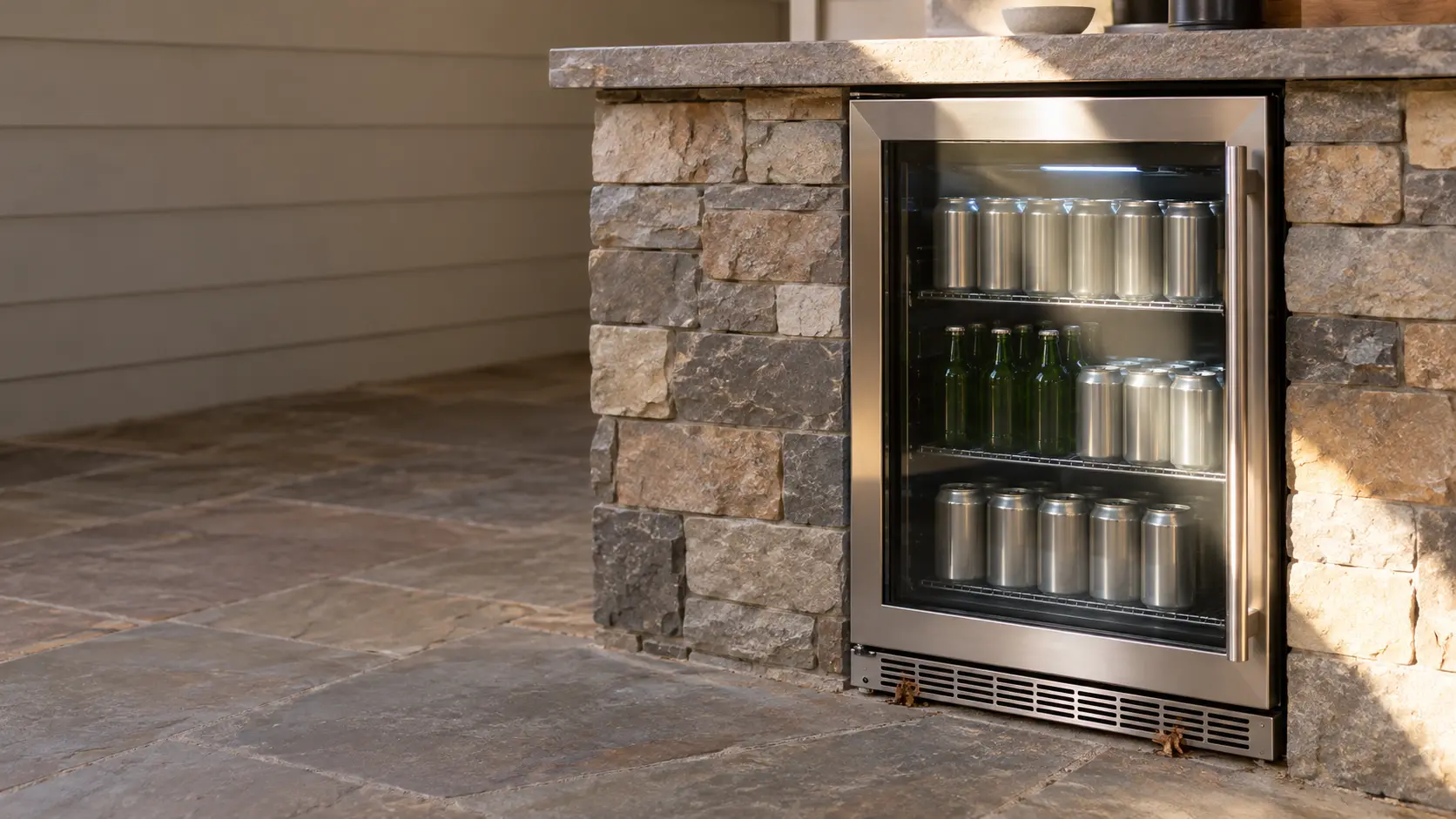
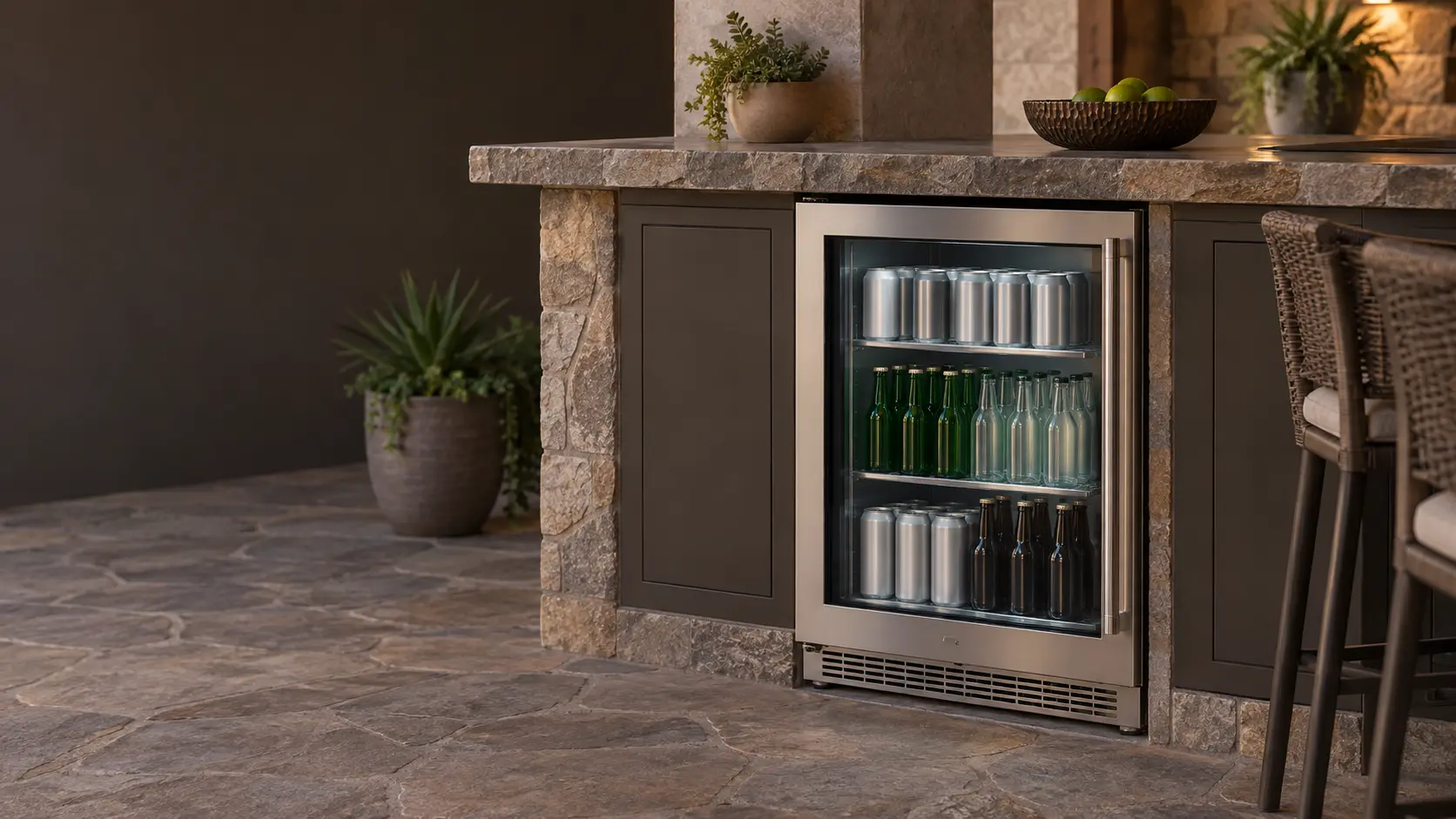
True's outdoor advice has a detail most owners have never heard: install the unit flush so the countertop overhangs and covers the door or drawer gasket, in an opening at least 24 inches deep. The reason is written in capitals in the same guide: door and drawer gaskets do not provide a watertight seal against the elements. A counter edge that stops short lets rain run straight down the face of the door and into the seal.
Perlick asks for the counter above an undercounter unit to be supported by the cabinetry around it, with shims directly over the unit, and warns against heavy objects on the counter above the cabinet. Stone tops on outdoor islands are heavy; the unit should never carry them.
A patio floor that slopes by design
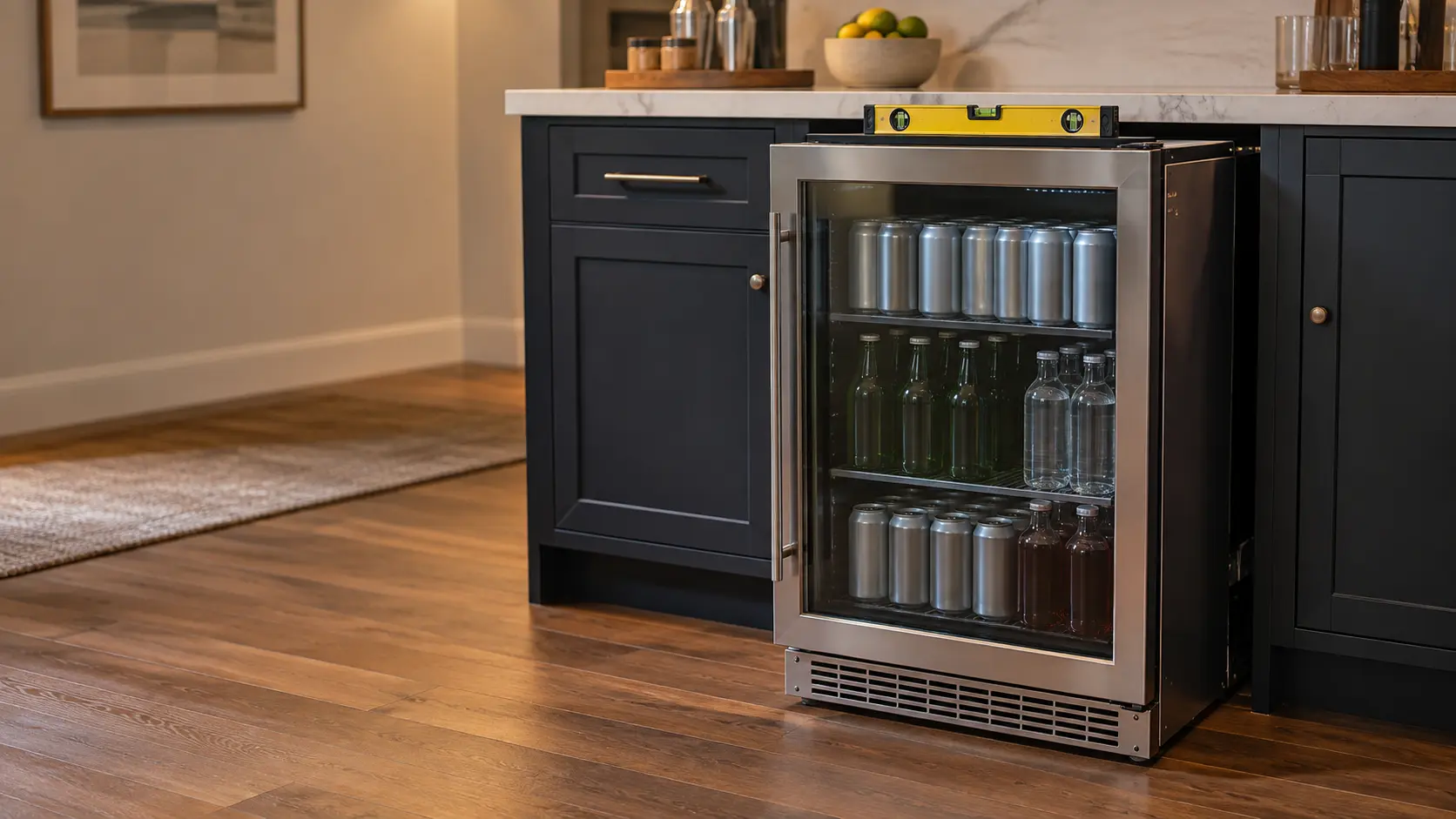
Patios are built to shed water, so the slab under an island is often not level. Perlick wants the floor under the unit at the same level as the surrounding finished floor. Plan a level pad inside the opening rather than relying on the leveling legs to take up a steep slope.
The anti-tip bracket
Outdoor units are opened with a loaded door by people leaning in from the side. Perlick and True supply anti-tip brackets and treat fastening them as part of the job; True says its units must have them installed. On a concrete slab, Perlick notes that concrete fasteners are needed and are not in the kit.
- Bracket fastened to the adjoining cabinet or the slab, as the manual shows.
- Concrete anchors bought separately for a slab.
- Legs leveled before the bracket is tightened, never after.
Source: True Residential — 15 and 24 inch Undercounter Installation Guide — All undercounter units are UL rated for outdoor use; vent the rear of the opening where ambient regularly exceeds 95°F; install flush with the countertop covering the gasket in an opening at least 24 inches deep because gaskets are not watertight; anti-tip brackets must be installed; dedicated circuit; winterize at a steady 32°F or below with a cover; run 24 hours before use; Perlick — G5 Installation and Operation Manual — Coastal grade within 1 mile of the coast, up to 5 miles, and near pools; beverage ambient 38°F to 105°F; support and shim the countertop, no heavy objects above; floor level with the finished floor; anti-tip bracket and concrete fasteners; do not cover the unit; spring start-up runs 24 hours; clean the condenser every 30 days; wait 24 hours after tilting past 45 degrees
Power outside the house
Outdoor units want the same grounded 115-volt, 15-amp supply as indoor ones, and True asks for a dedicated circuit for each unit. The difference is protection: the outlet will usually sit behind a GFCI, whatever the manual says about nuisance tripping, because local code decides. The GFCI guide covers why trips happen and how to test the device.
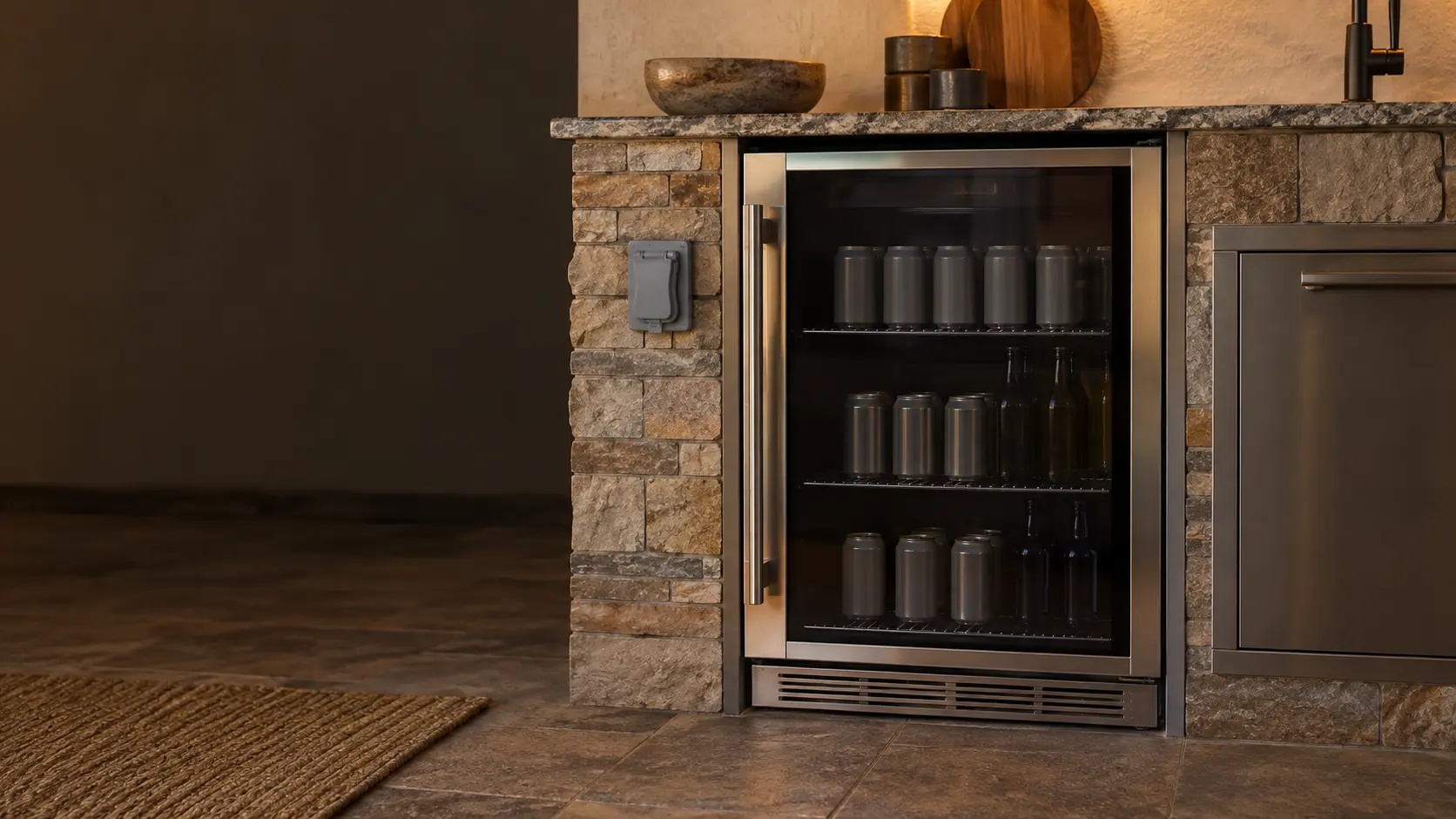
Every maker in this group forbids extension cords, and outdoors that rule matters twice. A cord run across a patio from a kitchen outlet is a trip hazard, a water hazard and a voltage drop at the compressor in one. The outlet belongs inside the island or on the wall behind it, placed by an electrician.
Source: True Residential — 15 and 24 inch Undercounter Installation Guide — All undercounter units are UL rated for outdoor use; vent the rear of the opening where ambient regularly exceeds 95°F; install flush with the countertop covering the gasket in an opening at least 24 inches deep because gaskets are not watertight; anti-tip brackets must be installed; dedicated circuit; winterize at a steady 32°F or below with a cover; run 24 hours before use
Winter shutdown and spring start-up
The makers disagree on details, so follow your own manual. True recommends winterizing once temperatures stay at 32°F or below: empty it, unplug it or switch it off, and cover it. U-Line sets the line at 40°F, and asks for the power cord unplugged, the inside cleaned and dried, and the door propped open at least 2 inches. Perlick takes the opposite view on covers and tells owners not to put one over the unit.
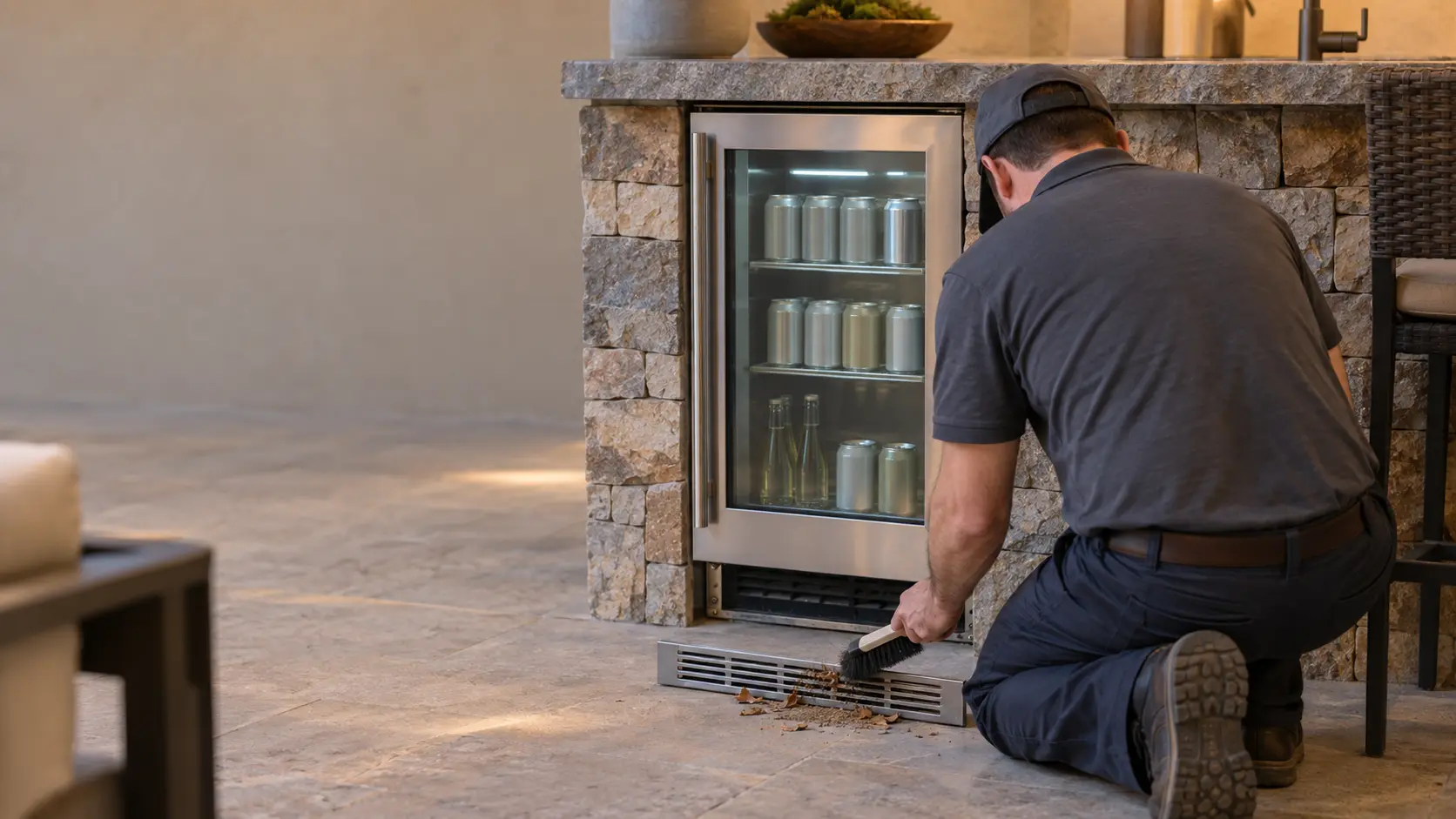
Spring is the gentler half. Perlick's start-up is to clean debris from the condenser, reattach the grille, restore power and run the unit for 24 hours before loading it; True asks for a 24-hour run on any new install as well. Perlick also recommends cleaning an outdoor condenser as often as every 30 days, because leaves and pollen collect behind the grille.
Source: U-Line — UORE124 Outdoor User Guide and Service Manual — Operates between 50°F and 100°F; higher ambient temperatures reduce the ability to reach low settings; keep out of direct sunlight and away from heat; winterize at 40°F or below by unplugging, cleaning, drying and leaving the door open at least 2 inches; True Residential — 15 and 24 inch Undercounter Installation Guide — All undercounter units are UL rated for outdoor use; vent the rear of the opening where ambient regularly exceeds 95°F; install flush with the countertop covering the gasket in an opening at least 24 inches deep because gaskets are not watertight; anti-tip brackets must be installed; dedicated circuit; winterize at a steady 32°F or below with a cover; run 24 hours before use; Perlick — G5 Installation and Operation Manual — Coastal grade within 1 mile of the coast, up to 5 miles, and near pools; beverage ambient 38°F to 105°F; support and shim the countertop, no heavy objects above; floor level with the finished floor; anti-tip bracket and concrete fasteners; do not cover the unit; spring start-up runs 24 hours; clean the condenser every 30 days; wait 24 hours after tilting past 45 degrees