What actually happens when a can freezes
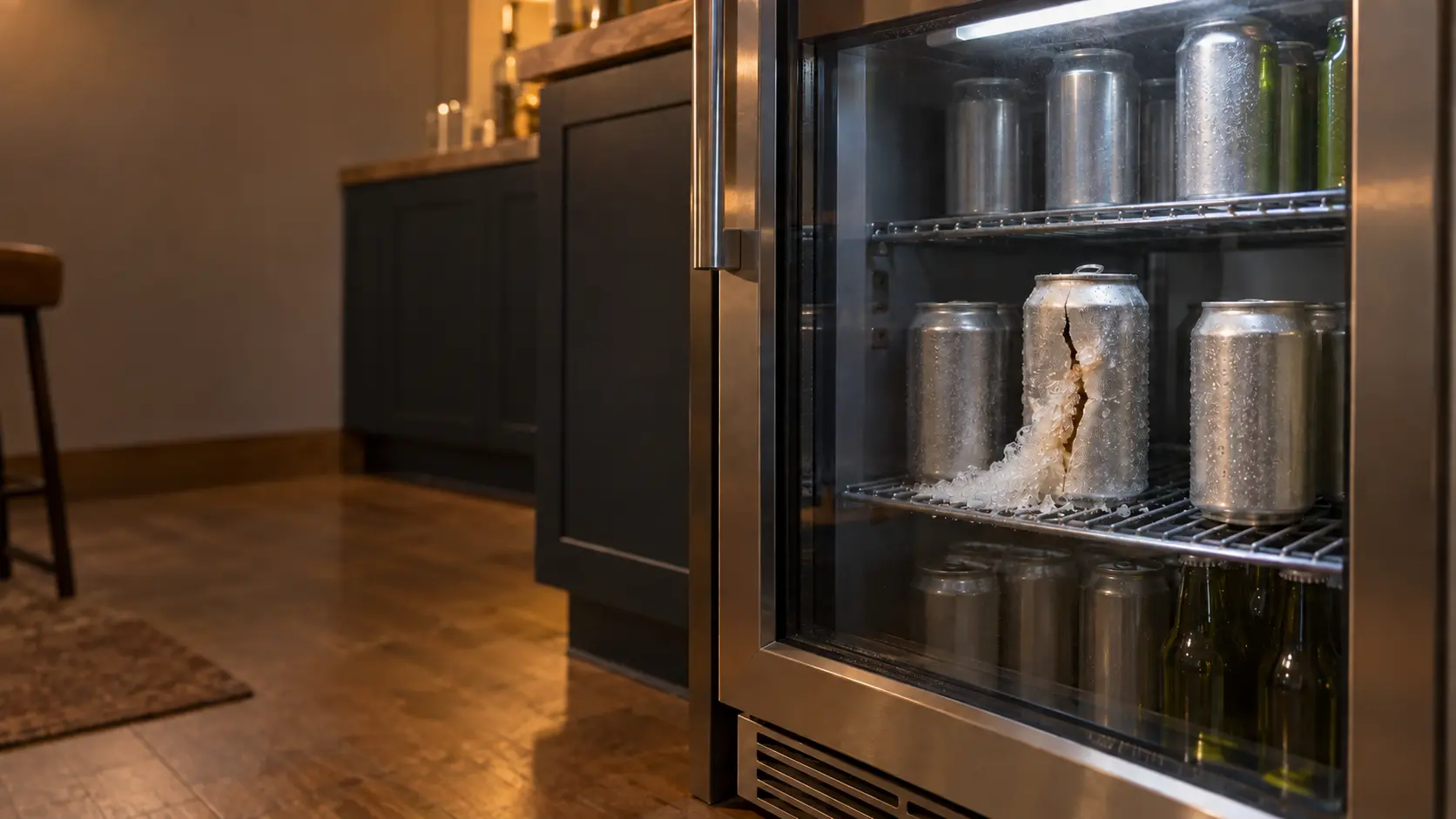
Soda, seltzer and beer are mostly water, and water takes up more room as ice than it did as liquid. An aluminum can has almost no spare space inside, so its ends dome outward first. A can with a bulged base may sit quietly on the shelf for days, then split along its seam when someone lifts it or the cabinet warms up again.
Glass does worse, because it cannot stretch at all, and a cracked bottle can drop its base onto the shelf below. Sugar and alcohol lower the freezing point a little, which is why a cabinet can leave cola as slush while plain sparkling water beside it turns solid. That spread is a useful gauge: if only the plainest drinks freeze, the cabinet is a hair too cold; if everything is ice, something larger is wrong.
- A domed top or base: the can froze at least once, even if it never leaked.
- Dried syrup on a shelf or the cabinet floor: one has already opened.
- Slush when poured: the cabinet is sitting right at the freezing line.
- A cracked bottle: lift it out with gloves on and check the shelf beneath for glass.
Start with the set point and what it really measures
U-Line's 1100 series guide gives 38°F as the factory set point for its beverage centers, and most makers ship in the upper 30s. Cans taste crisp there and keep a few degrees of margin above the point where plain water turns to ice. Households that like their drinks colder often step the setting down one click at a time until, one cold night, that margin is simply gone.
The number on the panel is air, not drinks
Marvel's owner's guide says plainly that air temperature does not indicate product temperature. Air inside the cabinet swings above and below the setting as the compressor starts and stops, and U-Line notes that its cabinets cooled without a fan run coolest toward the bottom. A setting of 34°F can therefore put the lowest shelf below freezing for part of every cycle while the display looks perfectly reasonable.
Measure the shelf where it happened
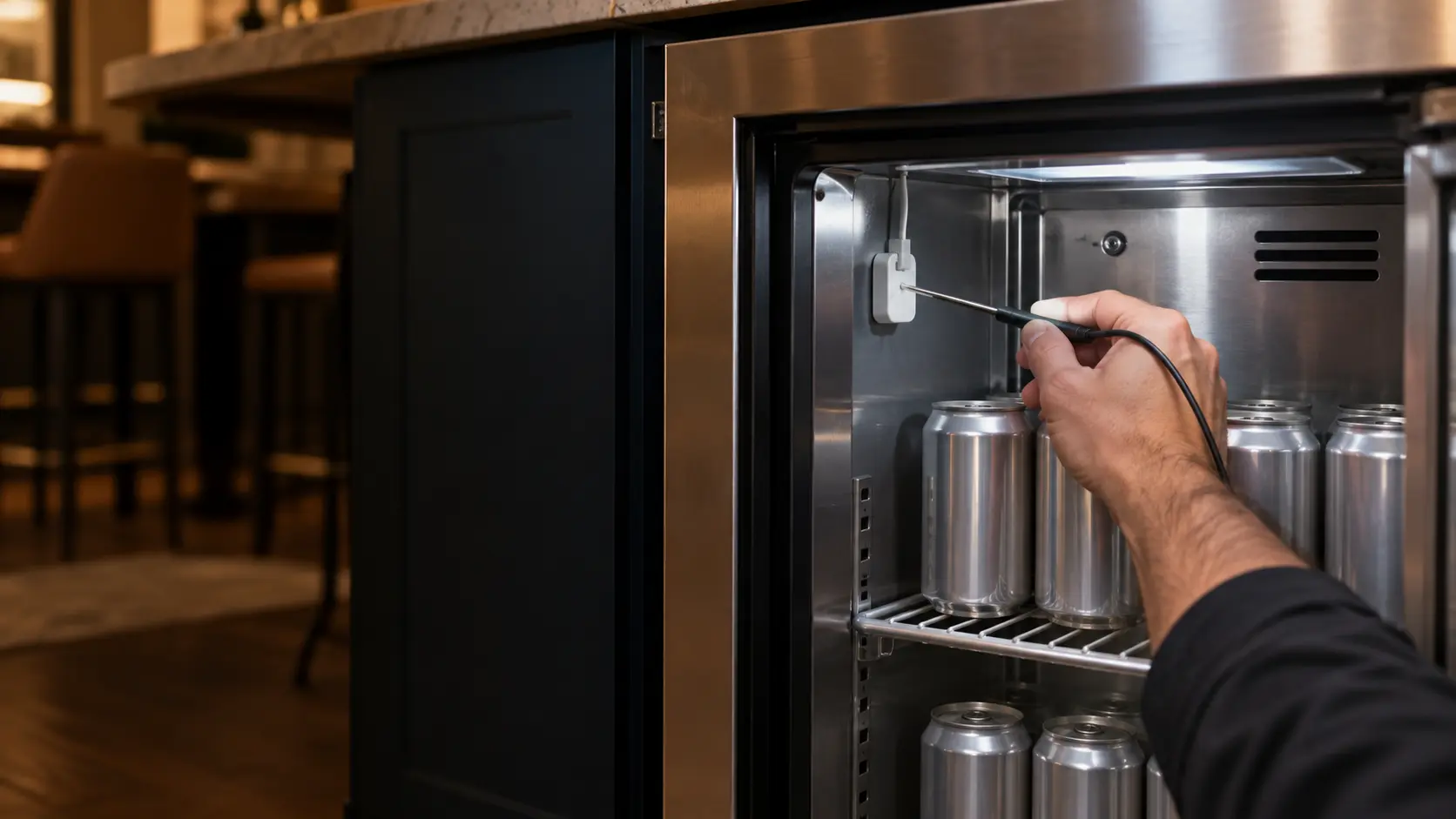
Put an accurate thermometer in a capped plastic bottle of water, stand it exactly where the cans froze, and leave the door shut for a full day. Marvel and U-Line both describe this check. If that bottle reads close to 32°F while the panel shows 36°F, the cabinet is layering cold at the bottom; raise the setting two degrees and repeat the test before suspecting any part.
Source: U-Line — 1100 and ADA series use and care guide (beverage centers) — Factory default set point for beverage centers is 38°F; units cooled without a fan are coolest toward the bottom; check product temperature with a thermometer in a capped bottle of water for 24 hours; frost on the rear wall is normal and melts each off cycle; the rear edge strip keeps cans and bottles from freezing against the evaporator; product touching the rear wall may freeze; do not use an ice pick or sharp instrument to defrost
The rear wall is the coldest surface in the cabinet
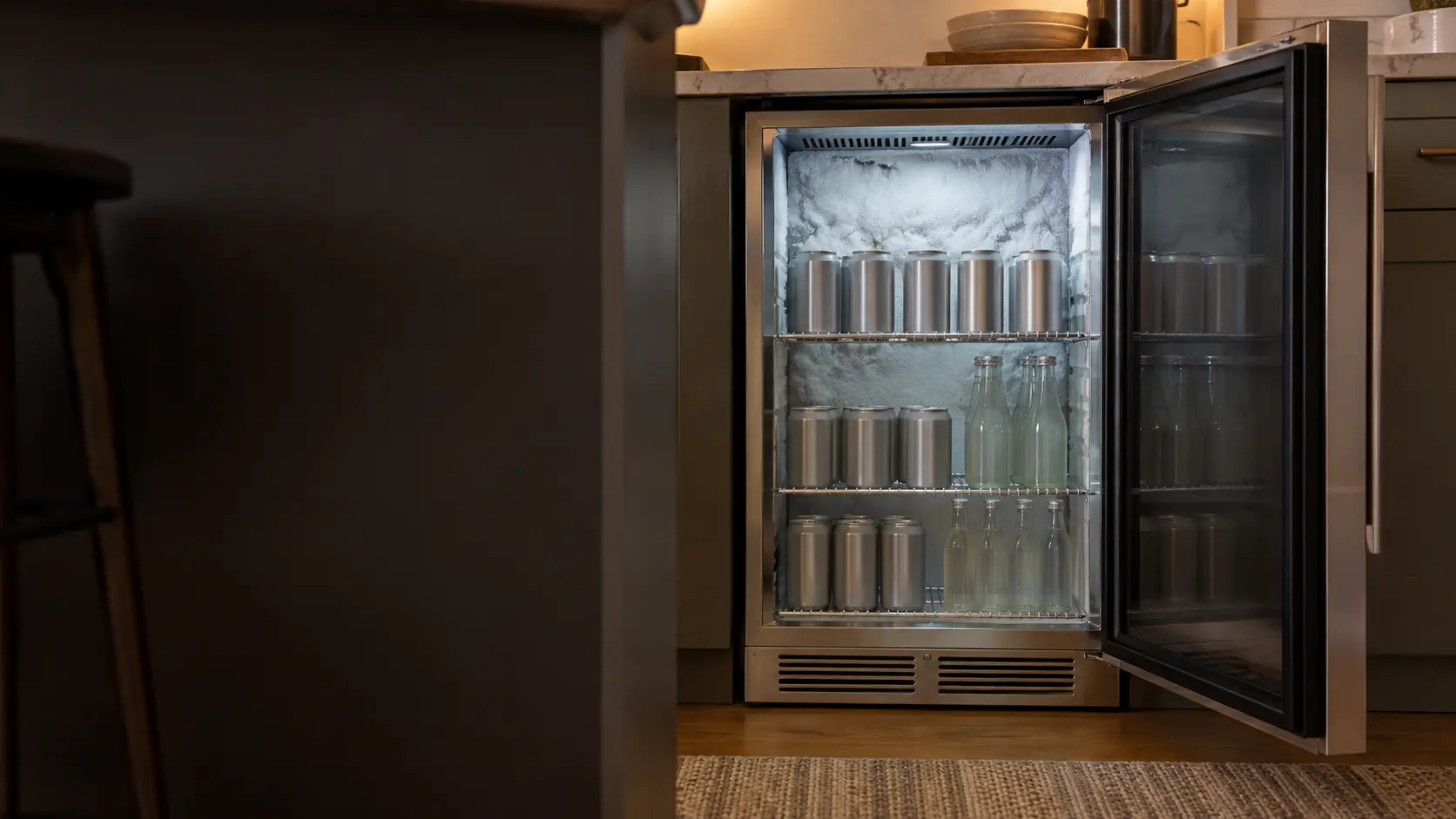
On many undercounter beverage centers the evaporator, the plate that pulls heat out of the air, sits behind or inside the rear wall. U-Line calls a light frost on that wall normal and says it melts during each off cycle. Anything leaning on it is resting against a surface well below freezing, whatever the display says.
- Pull each shelf and check which way its raised edge or rail points.
- Move the back row of cans forward by a finger's width.
- Look for a frost patch on the wall shaped like the cans that touched it.
The raised shelf edge that faces backward
U-Line's glass shelves carry a raised strip that has to face the rear, and its guide spells out the reason: the strip keeps cans and bottles from freezing against the cold evaporator. Slide a shelf back in the wrong way round after washing it and that stop is gone, so the next case loaded tight to the back is the one that freezes. Wire shelves on other makes often use an upturned rear rail for the same purpose.
Loading every inch before a party
A cabinet filled to the ceiling pushes cans into the back wall on every shelf and can bury the fan cover as well. Leave a finger's width between the rearmost row and the wall, and never stack a flat carton against the fan. U-Line's troubleshooting table names contact with the rear wall as the first thing to correct when product freezes, ahead of any change to the setting.
Source: U-Line — 1100 and ADA series use and care guide (beverage centers) — Factory default set point for beverage centers is 38°F; units cooled without a fan are coolest toward the bottom; check product temperature with a thermometer in a capped bottle of water for 24 hours; frost on the rear wall is normal and melts each off cycle; the rear edge strip keeps cans and bottles from freezing against the evaporator; product touching the rear wall may freeze; do not use an ice pick or sharp instrument to defrost
A cold room can freeze the drinks as well
It sounds backward, but a beverage center parked in a space that is too cold can freeze what it holds. A simple single-sensor control assumes the room will warm the cabinet between cycles; once a garage, porch or unheated basement falls below the design limit, that assumption fails. Perlick's G5 manual sets 38°F as the lowest room temperature for its refrigerator and beverage units, and Marvel's guide recommends a room between 55°F and 100°F for the model it covers.
An indoor model that lives in a seasonal space is the classic January burst. Outdoor-rated units are built for a wider band but still have a floor, and both Perlick and Marvel describe shutting the power off to a unit that must sit through freezing weather; Marvel also asks for the contents to come out, and its threshold for that step is 40°F.
Porches, garages and lake houses
A cabinet that behaved all summer and starts freezing cans in the first cold week is telling you about the room. Check the space itself with a thermometer at night. If it drops into the 30s, the answer is a warmer spot, the winter shutdown in the manual, or a unit rated for the location, not a new part.
Source: Marvel — Owner's guide and service manual, 24-inch beverage center (MLBV224) — Air temperature does not indicate product temperature; the water-bottle check; recommended installation room of 55°F to 100°F; winterize when exposed to 40°F or less; a failed zone thermistor leaves the unit cooling in a backup mode; Perlick — G5 undercounter user, installation and operation manual — Lower room temperature of 38°F for refrigerator and beverage units, with winterizing below it by cutting power at the master switch, the plug or the breaker; the control stores low zone temperature alarms in a date-stamped history
When it freezes at a sensible setting
If the bottle test reads below 32°F with the control at 38°F, the room is warm, the shelves face the right way and nothing touches the back wall, the cause is inside the unit. The usual candidates are the temperature sensor, which can drift and report the cabinet warmer than it is, and the control board that decides when the compressor runs. Marvel's service manual notes that when its zone sensor fails the unit keeps cooling in a backup mode, so a cabinet can carry on running with no reliable sense of its own temperature.
Some controls announce the problem. KitchenAid lists CL or LO on its beverage centers as an inside temperature that is too low, and Perlick's G5 control records low-zone temperature alarms in its history. Copy any code character for character before it is cleared, then look it up in our error code pages, which sort them by family.
Source: Marvel — Owner's guide and service manual, 24-inch beverage center (MLBV224) — Air temperature does not indicate product temperature; the water-bottle check; recommended installation room of 55°F to 100°F; winterize when exposed to 40°F or less; a failed zone thermistor leaves the unit cooling in a backup mode; Perlick — G5 undercounter user, installation and operation manual — Lower room temperature of 38°F for refrigerator and beverage units, with winterizing below it by cutting power at the master switch, the plug or the breaker; the control stores low zone temperature alarms in a date-stamped history; KitchenAid — CL or LO error code, beverage center — CL or LO means the internal temperature is too low; a recent power outage and a door left open are among the listed checks
Cleaning up after a burst
Switch the unit off or unplug it before reaching in, because spilled soda runs back toward the drain trough and the fan. Lift out the affected shelf, wash it in warm water with a drop of dish soap, and wipe the liner and the door gasket, where sugar dries into a tacky film. A shattered bottle calls for gloves, one shelf at a time, and a vacuum along the bottom rail where small fragments hide.
Give the gasket that extra minute. A seal that stays sticky pulls away from the cabinet each time the door opens and can hold it a fraction ajar, which lets damp room air in and feeds frost to the very wall that froze the cans.