Which beverage center noises are normal?
A steady low hum, a faint whoosh of air and the odd click are normal beverage center noise, and a quiet room makes all of them louder than they are in the daytime. The unit cools with the same kind of sealed system as a kitchen cooling appliance, but a smaller cabinet, thin glass and often a hollow cabinet around it carry the sound further.
The hum and the whoosh
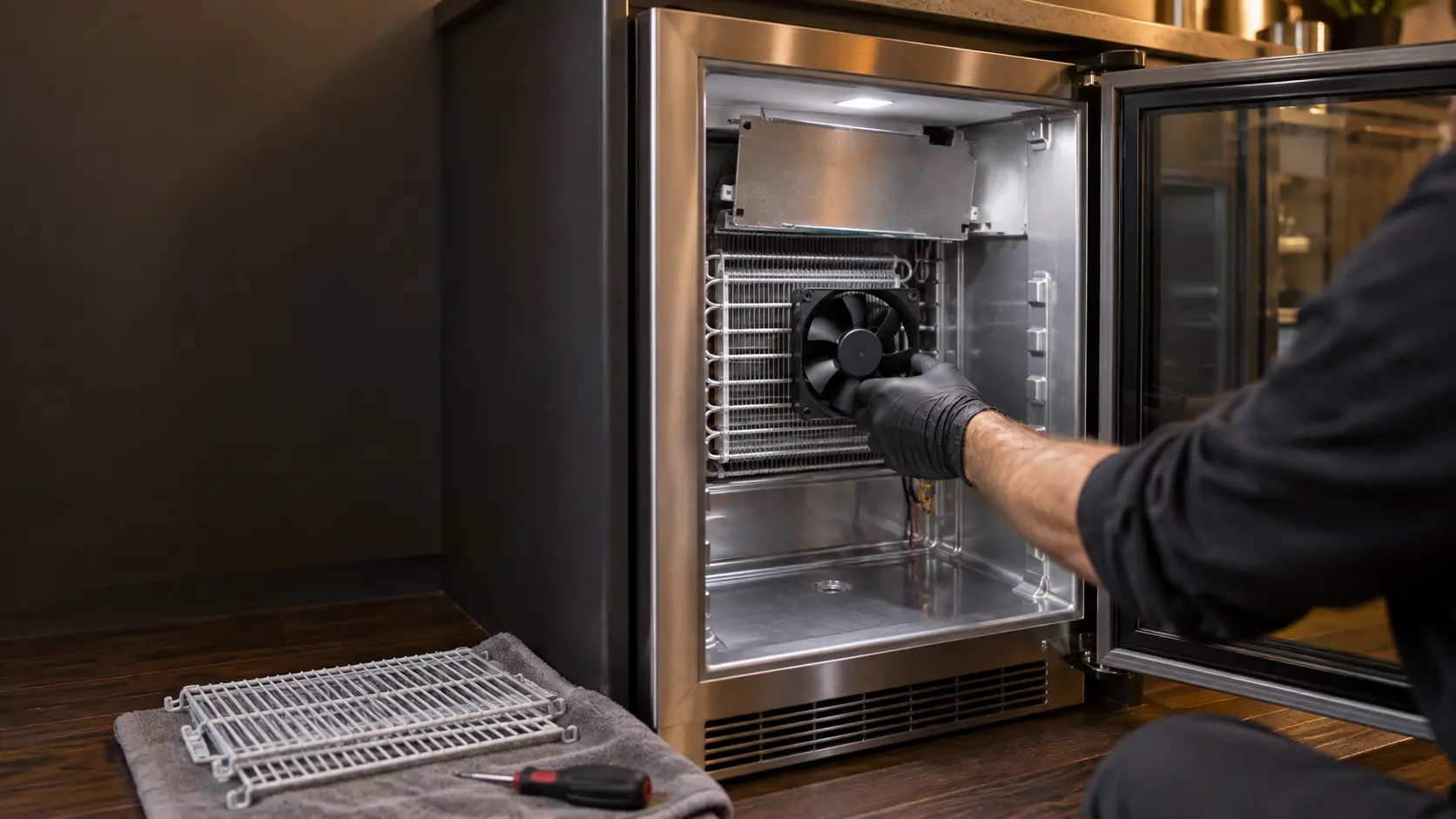
The compressor makes the hum. It cycles on and off, so the sound comes and goes over the hour, and a unit that has just been loaded or opened often will run for longer stretches. The whoosh is a small fan moving air over the cooling coil or the condenser, and on many models it speeds up and slows down with the cabinet temperature.
Clicks, pops and gurgles
A click at the start or end of a cycle is the compressor's relay or the thermostat switching. A soft pop or tick is plastic and metal changing size as the cabinet cools or warms. A short gurgle or trickle just after the compressor stops is refrigerant settling in the coil; it should last a few seconds, not minutes.
Which part makes which sound?
Most beverage center sounds trace back to one of five places, and the character of the sound usually points to the right one. The table gives the usual match as a general rule of thumb, not a diagnosis, because a loose part can make any of them louder and models differ.
| Sound | Most likely source | Usual verdict |
|---|---|---|
| Steady low hum, comes and goes | Compressor | Normal |
| Soft whoosh that follows the cycle | Condenser or evaporator fan | Normal |
| Single click at start or stop | Relay or thermostat | Normal |
| Short gurgle after the cycle ends | Refrigerant settling | Normal |
| Ticking or popping while cooling | Cabinet and shelves changing size | Normal |
| Rattle that changes with the cycle | Loose panel, shelf or tubing | Fix soon |
| Buzz or whine that rises and falls | Fan motor or blade touching something | Fix soon |
| Click, pause, click, no cooling | Compressor not starting | Book a visit |

What are the rattles, buzzes and vibration?
A rattle or buzz is usually a loose or touching part rather than a failing one, and it is the easiest kind of noise to cure. These sounds tend to appear after a move, after the unit has been pushed back into its opening, or after a bottle has been placed where it was not meant to go.
Things that vibrate against the cabinet
Look for these before anything else:
- A bottle or can resting against the back wall or a fan guard.
- A shelf that has slipped out of its supports or sits unevenly.
- A drawer or door whose gasket has lifted so the glass buzzes at the edge.
- A bottle neck touching its neighbor in a full rack.
- The cabinet touching the side of the cutout, a cabinet door or a wall.
An unlevel cabinet
A unit that rocks even slightly passes its hum into the floor and the surrounding cabinets, which turn it into a drone. Our guide on leveling a beverage center and planning the door swing shows how to set the feet so the cabinet sits firm.
A fan that buzzes or whines
A fan makes a steady rushing sound when healthy. A buzz, a whine, or a clicking like a card in bicycle spokes points to a blade touching something, dust built up on the blades, or a motor wearing out. Cleaning the front vent and coil helps when the cause is dust; cleaning the front grille and the coil behind it covers that. A motor that keeps whining after cleaning is a job for beverage center fan repair.
Which sounds come before a failure?
The sounds that matter are the ones that change, get louder, or arrive with a symptom. A noise that has been the same for two years is almost always the unit's own character; a new one deserves a look within the week.
- A hum that never stops, with drinks warmer than their setting, can mean the compressor is working but not cooling. See why the drinks are not cold for the checks that come first.
- Clicking every few minutes with no hum between is a compressor that tries to start and gives up. That one needs a visit.
- A loud grinding or scraping that began suddenly is a failing fan bearing or something fallen into the fan.
- A buzz coming from the electrical area on the back or bottom, especially with a hot smell, is a reason to unplug the unit.
- Gurgling that lasts minutes, or hissing when the unit is idle, can point to a sealed-system problem and belongs with compressor and sealed system repair.
For the general complaint, the noisy beverage center problem page lists the common causes by type of unit.
How do you quiet it down tonight?
Four checks take ten minutes and cure most nighttime complaints. Do them in this order, with the unit still plugged in, and stop at the first one that changes the sound.
- Open the door and listen. If the noise stops or changes, a bottle, shelf or gasket is involved; move bottles away from the back and the fan guard and reseat the shelves.
- Press gently on the top and sides of the cabinet with a flat hand. If the sound softens, it is a loose panel or a unit touching its surroundings; leave a small gap on every side.
- Check that the feet or leveling legs carry weight evenly and the unit does not rock.
- Look at the front vent. A vent blocked by a rug, a box or a cabinet panel makes the fan work louder and the compressor run longer.
Undercounter units fitted tight in a bar run louder than the same model on open floor, because the cabinet around them acts as a sounding board. If the unit sits in a closed run of joinery, see airflow for a built-in beverage center before blaming the machine.
Placing thin rubber or felt pads under the feet of a freestanding unit, kept clear of any vent at the base, or a firm shelf liner under a rack of bottles, also helps; it will not cure a failing fan, but it takes the edge off a hum that travels through a hard floor.