What "indoor only" means in a manual
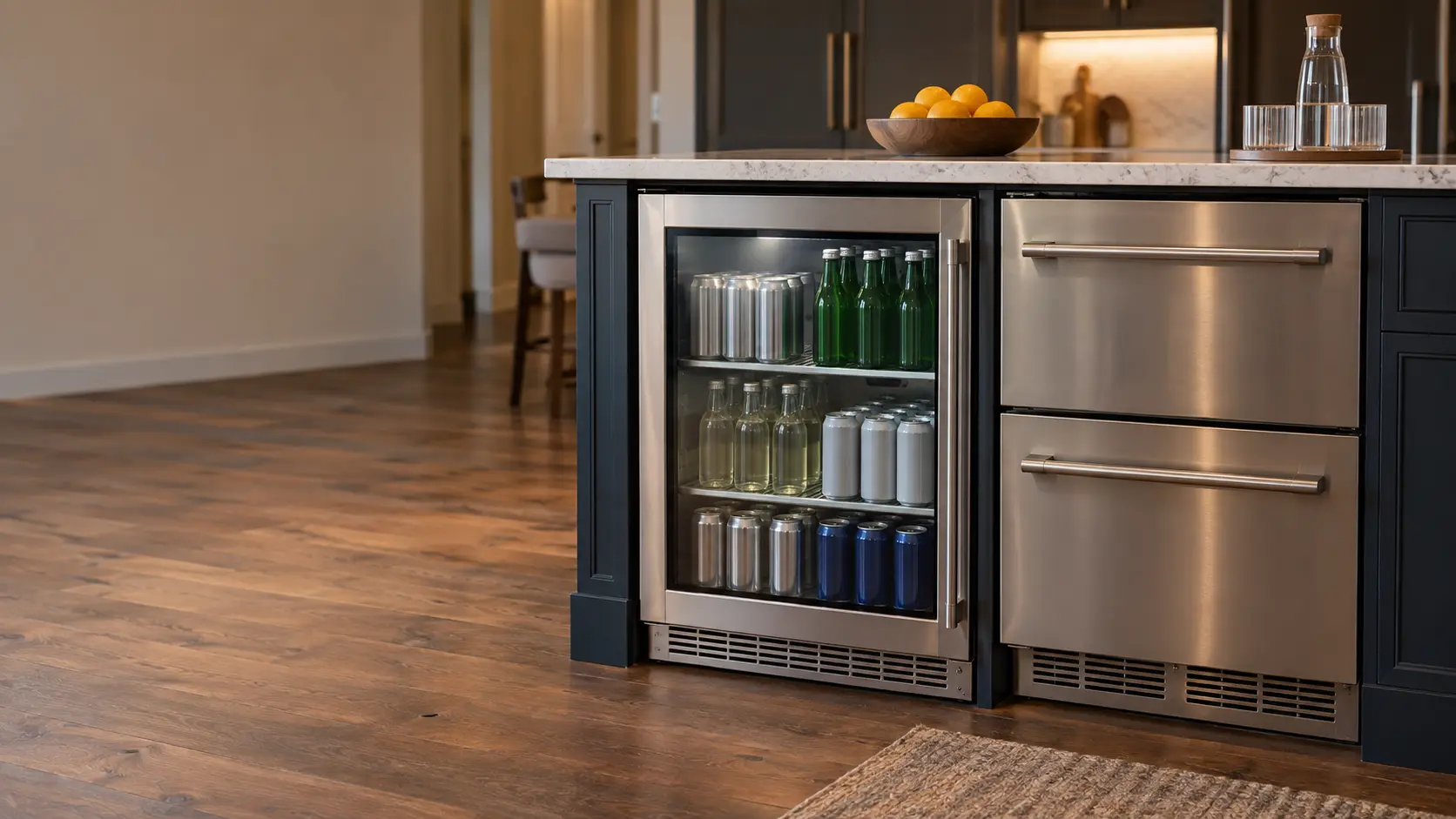
Indoor beverage centers are not flimsy, they are tuned for a room. U-Line limits its 24-inch indoor model to interior installations that are not open to the elements and lists an operating window of 50°F to 100°F. Zephyr's glass-door beverage cooler is stricter, asking for a spot above 50°F and below 90°F, and its guide carries a warning not to install or store it outdoors at all.
Those limits exist because the sealed system is sized for them. On a south-facing patio in July the air at the grille can pass those figures by noon, and the cabinet will run without resting and still let the cans warm. Below the lower limit the opposite happens: the thermostat rarely calls for cooling, and some units let the contents drift or even freeze.
Source: U-Line — 24" beverage center user guide (UHBV124) — Indoor use only, operating ambient 50°F to 100°F, shutdown steps when exposed to 40°F or less, freezing damage not covered; Zephyr — Presrv beverage cooler use, care and installation guide (PRB24C01BG) — Do not store or install the appliance outdoors; ambient above 50°F and below 90°F
What an outdoor rating actually covers
A rated unit is built to live with weather, not to ignore it. True Residential states that all of its undercounter models are UL-rated for outdoor use, and in the same breath its installation guide adds conditions that decide how well one performs outside.
None of those conditions is exotic, and together they explain why two rated units on similar patios can behave so differently. The one under a deep roof, flush in its cutout and stocked full, rarely sees a technician; the one facing the afternoon sun in an open-backed frame sees one most summers.
Heat and direct sun
Where the air regularly passes 95°F, True recommends venting the back of the cutout with an opening of about 4 by 10 inches. Direct afternoon sun on the glass adds load no vent can remove, so a spot under a roof, a pergola with a solid cover or the shaded side of an island matters more than the listing.
Rain, hose spray and the gasket
True notes that door and drawer gaskets are not a watertight seal against the elements. Its answer is a flush installation in a cutout at least 24 inches deep, with the countertop overhanging the gasket. Keep sprinklers and a pressure washer off the front, and never hose the grille clean.
Humid air and the glass
On sticky evenings a rated cabinet may sweat on the glass and around the seals, and True calls that possible in high-dewpoint regions, advising a fully stocked cabinet for the steadiest result. Beads on the outside that clear as the air dries are weather, not a broken unit.
Source: True Residential — 15" and 24" undercounter installation manual — UL-rated for outdoor use; vent the cutout rear where ambient exceeds 95°F; gaskets not watertight; flush install in a 24-inch-deep cutout; condensation in high dewpoints; winterize at a consistent 32°F with a cover; dedicated 115 V 15 A circuit, no extension cords

A winter plan, set before the first frost
Makers disagree on the details, so follow your own guide. Perlick recommends winterizing its outdoor beverage center models once the daily low reaches 42°F and says not to cover the unit, while True waits for temperatures that consistently reach 32°F and suggests placing a cover over it. Both agree the cabinet should be emptied and switched off.
An indoor model left outside has no such plan behind it. U-Line's indoor guide tells owners to follow the shutdown steps whenever the unit will see 40°F or less, and it excludes damage from freezing temperatures.
- Empty every can and bottle; a frozen can splits and leaves a sticky mess on the shelves.
- Switch the unit off at its control, or unplug it or turn off its breaker from a dry spot.
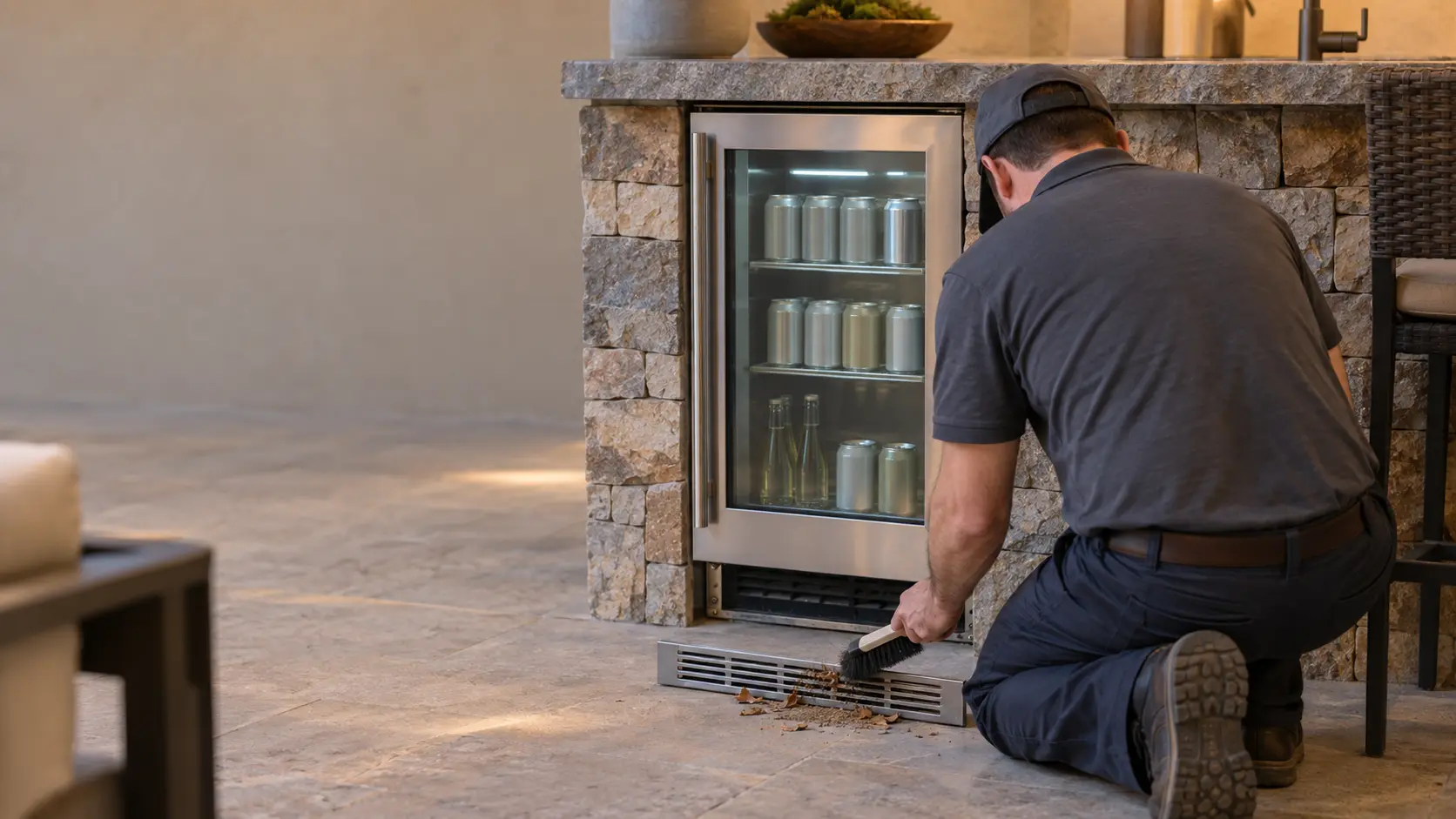
- Take off the front grille and vacuum leaves and dust out of the condenser area.
- Wipe the interior dry and follow the maker's advice on covering it or leaving it open.
Source: U-Line — 24" beverage center user guide (UHBV124) — Indoor use only, operating ambient 50°F to 100°F, shutdown steps when exposed to 40°F or less, freezing damage not covered; True Residential — 15" and 24" undercounter installation manual — UL-rated for outdoor use; vent the cutout rear where ambient exceeds 95°F; gaskets not watertight; flush install in a 24-inch-deep cutout; condensation in high dewpoints; winterize at a consistent 32°F with a cover; dedicated 115 V 15 A circuit, no extension cords; Perlick — Residential FAQs (winterizing outdoor products) — Winterize beverage center models when the daily low is at or below 42°F, do not cover the unit; outdoor models can be used indoors
Porches, garages and pool houses
A roof does not make a space indoor. A screened porch, an unheated garage or a pool house sees the same heat and cold as the yard, only without rain, and to the cabinet that is still outdoors. If the space is not heated in winter and cooled in summer, treat it as an outdoor location and choose a rated unit.
Perlick notes that its outdoor models may also be used indoors, so a rated cabinet costs nothing in flexibility. The reverse never holds.
Placement inside a rated space still counts. Keep the grille clear of planters and stacked chair cushions, leave the door swing free of the path to the pool, and avoid a spot where a grill or fire feature blows hot air across the front.
Source: Perlick — Residential FAQs (winterizing outdoor products) — Winterize beverage center models when the daily low is at or below 42°F, do not cover the unit; outdoor models can be used indoors
Power at an outdoor counter
True asks for a dedicated 115-volt, 15-amp circuit and a grounded three-prong outlet, and rules out extension cords and adapters. Outdoors that outlet also needs GFCI protection, which the GFCI guide in this site's safety section covers in detail. Plan it before the counter is built, since the outlet usually ends up behind the unit.
An indoor unit that has lived outside tends to show a pattern once it starts failing. The signs below usually mean the location, not a part, is the real problem.
- Warm cans every afternoon and cold ones again after dark.
- Rust spots on the cabinet floor or around the hinges.
- A GFCI that trips after rain or a heavy dew.
- A compressor that seems never to stop on hot days.
Source: True Residential — 15" and 24" undercounter installation manual — UL-rated for outdoor use; vent the cutout rear where ambient exceeds 95°F; gaskets not watertight; flush install in a 24-inch-deep cutout; condensation in high dewpoints; winterize at a consistent 32°F with a cover; dedicated 115 V 15 A circuit, no extension cords